Steel Angle Sizes: Dimensions and Weight Chart
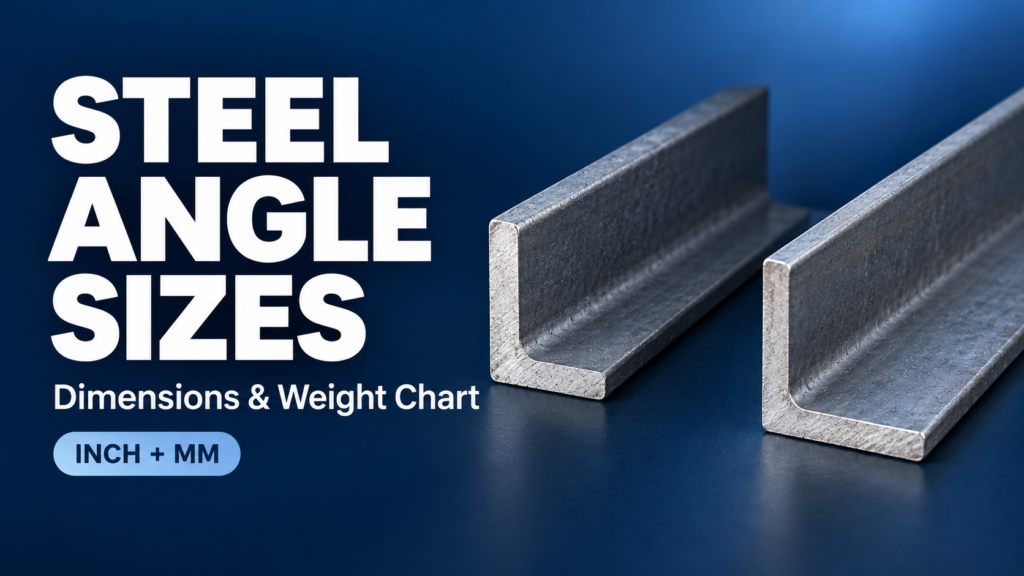
Steel angle sizes identify the two leg lengths and the thickness of an L-shaped steel section. For example, L4 × 3 × 1/4 means a 4-inch leg, a 3-inch leg, and a nominal thickness of 1/4 inch.
This guide explains angle designations, compares equal-leg and unequal-leg sections, and provides separate inch and mm dimension and weight charts for selected US hot-rolled steel angles.
How to Read Steel Angle Sizes
Read L4 × 3 × 1/4 from left to right:
- L: an angle with an L-shaped cross-section.
- 4: the longer leg is 4 inches.
- 3: the other leg is 3 inches.
- 1/4: the nominal thickness of the legs is 0.25 inch.
For an equal-leg angle, the first two dimensions match. L3 × 3 × 1/4 has two 3-inch legs and the same 1/4-inch nominal thickness.
These dimensions describe the cross-section. They do not tell you the member’s cut length or steel grade. A complete material callout should specify those separately.
Angle Cross-Section: Leg A, Leg B, and Thickness
Measure each leg along its outside face from the back of the heel to the end of that leg. Do not use the clear inside length as the nominal leg dimension. The rounded inside heel also reduces the usable flat space near the corner.
Equal-Leg vs. Unequal-Leg Steel Angles
| Feature | Equal-leg angle | Unequal-leg angle |
|---|---|---|
| Leg dimensions | A = B | A and B differ |
| Example | L4 × 4 × 1/4 | L4 × 3 × 1/4 |
| Layout consideration | Matching leg widths on both sides | A wider leg on one side for the required layout |
| Detailing check | Which leg is connected and where the load acts | Which way the long leg faces, plus the connection and load position |
Neither type is automatically the better structural choice. The required loads, member length, orientation, and connection determine whether a section is suitable. Equal legs do not make an angle equally strong in every direction.
Steel Angle Sizes: Dimensions and Weight Charts
The charts contain 32 selected sizes: 16 equal-leg and 16 unequal-leg angles. Search by designation or choose an angle type. The MM chart lists the same US sections with converted dimensions and unit weights; it is not a separate list of European or other metric-standard angles.
Steel Angle Sizes — INCH Chart
Equal & unequal legs · dimensions in in · weight in lb/ft
| Section | Type | Leg A (in) | Leg B (in) | Thickness t (in) | Weight (lb/ft) |
|---|---|---|---|---|---|
| L3 × 3 × 3/16 | Equal | 3 | 3 | 0.1875 | 3.71 |
| L3 × 3 × 1/4 | Equal | 3 | 3 | 0.25 | 4.9 |
| L3 × 3 × 3/8 | Equal | 3 | 3 | 0.375 | 7.2 |
| L3 × 3 × 1/2 | Equal | 3 | 3 | 0.5 | 9.4 |
| L4 × 4 × 1/4 | Equal | 4 | 4 | 0.25 | 6.6 |
| L4 × 4 × 3/8 | Equal | 4 | 4 | 0.375 | 9.8 |
| L4 × 4 × 1/2 | Equal | 4 | 4 | 0.5 | 12.8 |
| L4 × 4 × 3/4 | Equal | 4 | 4 | 0.75 | 18.5 |
| L5 × 5 × 3/8 | Equal | 5 | 5 | 0.375 | 12.3 |
| L5 × 5 × 1/2 | Equal | 5 | 5 | 0.5 | 16.2 |
| L6 × 6 × 3/8 | Equal | 6 | 6 | 0.375 | 14.9 |
| L6 × 6 × 1/2 | Equal | 6 | 6 | 0.5 | 19.6 |
| L6 × 6 × 3/4 | Equal | 6 | 6 | 0.75 | 28.7 |
| L8 × 8 × 1/2 | Equal | 8 | 8 | 0.5 | 26.4 |
| L8 × 8 × 3/4 | Equal | 8 | 8 | 0.75 | 38.9 |
| L8 × 8 × 1 | Equal | 8 | 8 | 1 | 51 |
| L3 × 2 × 3/16 | Unequal | 3 | 2 | 0.1875 | 3.07 |
| L3 × 2 × 1/4 | Unequal | 3 | 2 | 0.25 | 4.1 |
| L3 × 2 × 3/8 | Unequal | 3 | 2 | 0.375 | 5.9 |
| L3 × 2 × 1/2 | Unequal | 3 | 2 | 0.5 | 7.7 |
| L4 × 3 × 1/4 | Unequal | 4 | 3 | 0.25 | 5.8 |
| L4 × 3 × 3/8 | Unequal | 4 | 3 | 0.375 | 8.5 |
| L4 × 3 × 1/2 | Unequal | 4 | 3 | 0.5 | 11.1 |
| L5 × 3 × 1/4 | Unequal | 5 | 3 | 0.25 | 6.6 |
| L5 × 3 × 3/8 | Unequal | 5 | 3 | 0.375 | 9.8 |
| L5 × 3 × 1/2 | Unequal | 5 | 3 | 0.5 | 12.8 |
| L6 × 4 × 3/8 | Unequal | 6 | 4 | 0.375 | 12.3 |
| L6 × 4 × 1/2 | Unequal | 6 | 4 | 0.5 | 16.2 |
| L6 × 4 × 3/4 | Unequal | 6 | 4 | 0.75 | 23.6 |
| L8 × 4 × 1/2 | Unequal | 8 | 4 | 0.5 | 19.6 |
| L8 × 6 × 1/2 | Unequal | 8 | 6 | 0.5 | 23 |
| L8 × 6 × 3/4 | Unequal | 8 | 6 | 0.75 | 33.8 |
Steel Angle Sizes — MM Chart
Equal & unequal legs · dimensions in mm · weight in kg/m
| Section | Type | Leg A (mm) | Leg B (mm) | Thickness t (mm) | Weight (kg/m) |
|---|---|---|---|---|---|
| L3 × 3 × 3/16 | Equal | 76.20 | 76.20 | 4.76 | 5.52 |
| L3 × 3 × 1/4 | Equal | 76.20 | 76.20 | 6.35 | 7.29 |
| L3 × 3 × 3/8 | Equal | 76.20 | 76.20 | 9.52 | 10.71 |
| L3 × 3 × 1/2 | Equal | 76.20 | 76.20 | 12.70 | 13.99 |
| L4 × 4 × 1/4 | Equal | 101.60 | 101.60 | 6.35 | 9.82 |
| L4 × 4 × 3/8 | Equal | 101.60 | 101.60 | 9.52 | 14.58 |
| L4 × 4 × 1/2 | Equal | 101.60 | 101.60 | 12.70 | 19.05 |
| L4 × 4 × 3/4 | Equal | 101.60 | 101.60 | 19.05 | 27.53 |
| L5 × 5 × 3/8 | Equal | 127.00 | 127.00 | 9.52 | 18.30 |
| L5 × 5 × 1/2 | Equal | 127.00 | 127.00 | 12.70 | 24.11 |
| L6 × 6 × 3/8 | Equal | 152.40 | 152.40 | 9.52 | 22.17 |
| L6 × 6 × 1/2 | Equal | 152.40 | 152.40 | 12.70 | 29.17 |
| L6 × 6 × 3/4 | Equal | 152.40 | 152.40 | 19.05 | 42.71 |
| L8 × 8 × 1/2 | Equal | 203.20 | 203.20 | 12.70 | 39.29 |
| L8 × 8 × 3/4 | Equal | 203.20 | 203.20 | 19.05 | 57.89 |
| L8 × 8 × 1 | Equal | 203.20 | 203.20 | 25.40 | 75.90 |
| L3 × 2 × 3/16 | Unequal | 76.20 | 50.80 | 4.76 | 4.57 |
| L3 × 2 × 1/4 | Unequal | 76.20 | 50.80 | 6.35 | 6.10 |
| L3 × 2 × 3/8 | Unequal | 76.20 | 50.80 | 9.52 | 8.78 |
| L3 × 2 × 1/2 | Unequal | 76.20 | 50.80 | 12.70 | 11.46 |
| L4 × 3 × 1/4 | Unequal | 101.60 | 76.20 | 6.35 | 8.63 |
| L4 × 3 × 3/8 | Unequal | 101.60 | 76.20 | 9.52 | 12.65 |
| L4 × 3 × 1/2 | Unequal | 101.60 | 76.20 | 12.70 | 16.52 |
| L5 × 3 × 1/4 | Unequal | 127.00 | 76.20 | 6.35 | 9.82 |
| L5 × 3 × 3/8 | Unequal | 127.00 | 76.20 | 9.52 | 14.58 |
| L5 × 3 × 1/2 | Unequal | 127.00 | 76.20 | 12.70 | 19.05 |
| L6 × 4 × 3/8 | Unequal | 152.40 | 101.60 | 9.52 | 18.30 |
| L6 × 4 × 1/2 | Unequal | 152.40 | 101.60 | 12.70 | 24.11 |
| L6 × 4 × 3/4 | Unequal | 152.40 | 101.60 | 19.05 | 35.12 |
| L8 × 4 × 1/2 | Unequal | 203.20 | 101.60 | 12.70 | 29.17 |
| L8 × 6 × 1/2 | Unequal | 203.20 | 152.40 | 12.70 | 34.23 |
| L8 × 6 × 3/4 | Unequal | 203.20 | 152.40 | 19.05 | 50.30 |
Data basis: Admiral Steel, Angles (Structural) catalog, pages 1–2. Imperial weights are the supplier’s published nominal values. Metric dimensions use 25.4 mm per inch, and kg/m values are converted from lb/ft and rounded to two decimals. This is a selected reference list, not a complete inventory or a guarantee of availability.
A Practical Comparison: Same Thickness, Different Legs
Compare L4 × 4 × 1/4 with L4 × 3 × 1/4. Both have a 4-inch leg and a 1/4-inch thickness. The equal-leg section weighs 6.6 lb/ft, while the unequal-leg section weighs 5.8 lb/ft in the source catalog.
The smaller second leg reduces weight, but also changes the section geometry and the available connection surface. These sections should not be substituted simply because one leg and the thickness match.
What the Weight Column Tells You
The weight column describes the steel section per unit length: lb/ft in the inch chart and kg/m in the mm chart. It does not describe how much load the angle can carry.
For a simple takeoff check, a 20-foot length of L4 × 4 × 1/4 is approximately 132 lb before additional plates, bolts, or coatings. Actual delivered weight can vary within the applicable product tolerances.
Drafting Checks Before Specifying an Angle
- Write the full size. “4-inch angle” leaves the second leg and thickness unclear.
- Show orientation. For unequal legs, show whether the long leg is vertical, horizontal, or connected. Define abbreviations such as LLV or LLH in the drawing notes if used.
- Check the heel clearance. Allow for the root radius and the space needed for bolts, washers, and adjacent parts.
- Separate section size from material grade. The L designation alone does not specify the steel’s strength.
- Confirm product type. A hot-rolled angle and a bent-plate angle may have different corner geometry and properties.
For load-bearing use, obtain the full section properties and applicable design checks. This chart supports dimension lookup and weight estimates, not structural capacity selection.
Frequently Asked Questions
Is the last number in an angle size its weight?
No. In L4 × 3 × 1/4, the last number is the nominal thickness in inches. This differs from a C-channel designation such as C6 × 8.2, where the second number is the weight per foot.
What is L4 × 3 × 1/4 in millimeters?
Its nominal dimensions are 101.60 × 76.20 × 6.35 mm. The US designation stays L4 × 3 × 1/4 in the metric chart so you can match it to the original drawing or material list.
Does “angle iron” mean cast iron?
Not in this chart. “Angle iron” is a common trade term, but these entries refer to hot-rolled steel angles.
Can I use the chart to choose an angle for a particular load?
No. Weight and outside dimensions are not enough. Member length, restraint, material, connection, load direction, and full section properties also matter.
Related Steel References
- Steel channel sizes and weight chart
- American wide-flange steel beam sizes
- HSS steel sizes and properties
References: Admiral Steel, Angles (Structural) catalog, pp. 1–2; Continental Steel & Tube Co., Angles – Structural Sizes, for cross-checking selected sizes. Use the applicable AISC section data and supplier documentation for project-specific verification.
MindCore