Steel Plate Weight Calculator: Pounds, Kilograms, and Thickness Chart
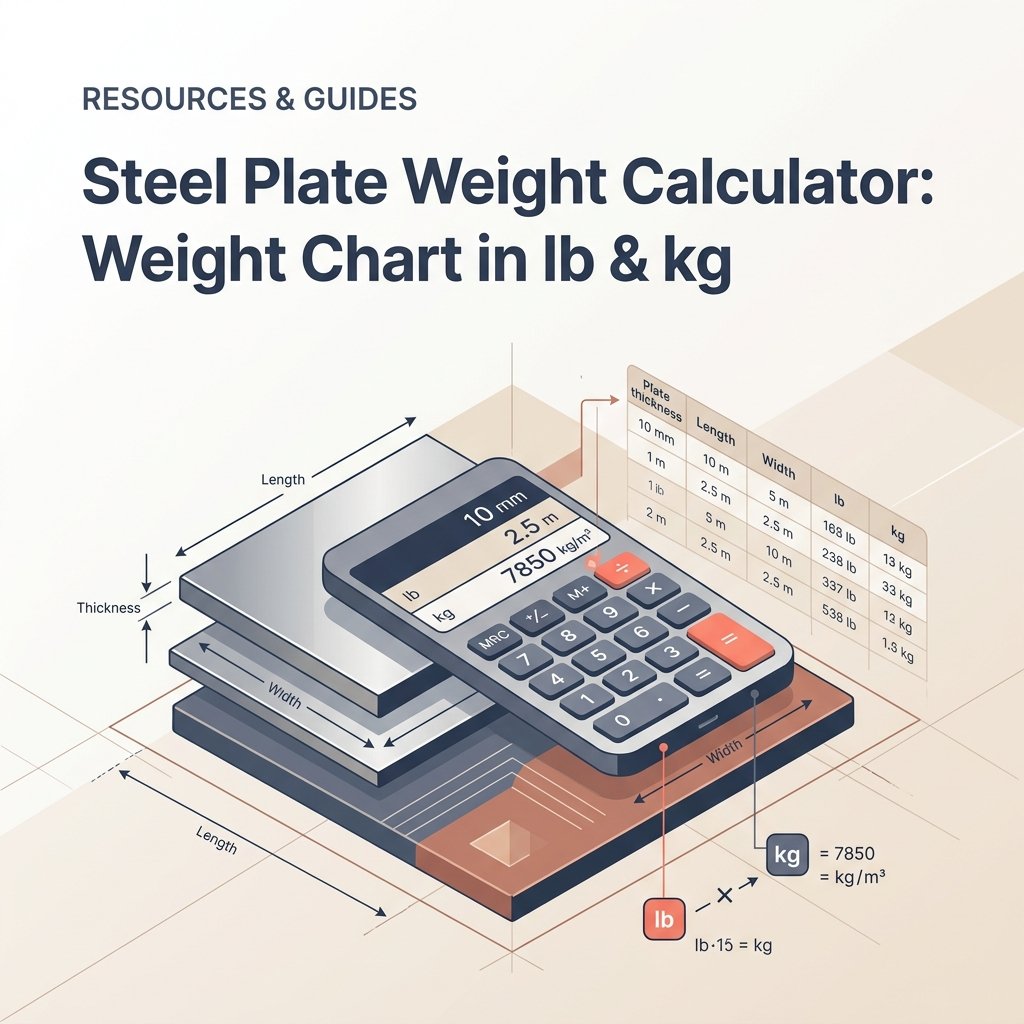
This steel plate weight calculator estimates the weight of a solid rectangular carbon steel plate. Enter the length, width, thickness, and quantity to see the weight of one plate and the full order in pounds and kilograms.
Use it for a quick material takeoff, a base plate estimate, or a comparison of plate thicknesses. The tables below also provide a quick reference when you do not need a custom size.
Steel Plate Weight Calculator
Choose the unit beside each dimension. For fractions, enter decimals: 1/4 = 0.25 and 3/8 = 0.375.
How to Use the Calculator
- Enter the finished rectangular plate dimensions.
- Select the unit for each dimension. For example, use feet for length and width, and inches for thickness.
- Enter the number of identical plates and select Calculate weight.
The calculator accepts mixed units and converts everything before calculating. Changing a unit changes how the entered number is interpreted; it does not convert the number automatically.
How Steel Plate Weight Is Calculated
The estimate is based on volume multiplied by density. This is also the method described by OnlineMetals in its metal weight calculation guide. Density values vary slightly among references and materials; this calculator consistently uses an assumed 7,850 kg/m³ unless you change it.
Weight (kg) = length (m) × width (m) × thickness (m) × 7,850
If all dimensions are in millimeters:
Weight (kg) = length (mm) × width (mm) × thickness (mm) × 0.00000785
For inch dimensions, the same density is approximately 0.283599 lb/in³. Multiply the three dimensions in inches by this factor to estimate pounds. The calculator retains full precision internally and rounds only the displayed results.
Example: A 4 ft × 8 ft × 1/4 in Plate
Enter 4 ft for length, 8 ft for width, and 0.25 in for thickness. At the default density, the estimated weight is:
- One plate: 326.71 lb (148.19 kg)
- Three plates: 980.12 lb (444.57 kg)
The default calculator inputs of 48 in × 96 in × 0.25 in describe this same plate.
Steel Plate Thickness and Weight Chart: Imperial
These theoretical weights use a density of 7,850 kg/m³. The final column is for a 4 ft × 8 ft rectangular plate, before any holes or cutouts.
| Thickness | Exact equivalent (mm) | lb/ft² | 4 × 8 ft plate (lb) |
|---|---|---|---|
| 1/8 in | 3.175 | 5.10 | 163.35 |
| 3/16 in | 4.762 | 7.66 | 245.03 |
| 1/4 in | 6.350 | 10.21 | 326.71 |
| 3/8 in | 9.525 | 15.31 | 490.06 |
| 1/2 in | 12.700 | 20.42 | 653.41 |
| 3/4 in | 19.050 | 30.63 | 980.12 |
| 1 in | 25.400 | 40.84 | 1306.83 |
Converted inch thicknesses are not interchangeable with nearby metric nominal thicknesses. For example, 1/4 in is 6.35 mm, not 6 mm.
Steel Plate Thickness and Weight Chart: Metric
| Thickness | kg/m² | 1 × 2 m plate (kg) |
|---|---|---|
| 3 mm | 23.55 | 47.10 |
| 4 mm | 31.40 | 62.80 |
| 5 mm | 39.25 | 78.50 |
| 6 mm | 47.10 | 94.20 |
| 8 mm | 62.80 | 125.60 |
| 10 mm | 78.50 | 157.00 |
| 12 mm | 94.20 | 188.40 |
| 16 mm | 125.60 | 251.20 |
| 20 mm | 157.00 | 314.00 |
| 25 mm | 196.25 | 392.50 |
A Practical Base Plate Takeoff
For a 12 in × 12 in × 1/2 in rectangular base plate, the estimated gross weight is 20.42 lb (9.26 kg). Ten identical plates total approximately 204.19 lb (92.62 kg).
When checking a drawing, confirm that the plate mark, dimensions, thickness, and quantity match the schedule. Calculate each different plate size separately, then add the totals. Anchor rods, stiffeners, weld metal, and other attached parts are separate items.
Why Actual Plate Weight Can Differ
This tool calculates a solid rectangular plate using the entered dimensions. It does not subtract bolt holes, slots, chamfers, or other cutouts. To estimate net weight, subtract the removed volume multiplied by the same density.
Actual thickness, manufacturing tolerances, material density, and coatings can change the measured weight. Packaging is also excluded. Use supplier weights or measured weights when a precise shipping or handling total is required.
Common Questions
Does doubling the thickness double the weight?
Yes, if length, width, and density stay the same. Doubling the number of identical plates also doubles the total weight.
Can I use a gauge number as the thickness?
Enter a physical thickness in inches or millimeters, not a gauge number. Confirm the applicable gauge-to-thickness conversion with the material supplier first.
Does this calculate how much load the plate can support?
No. It estimates the plate’s own weight. Load capacity depends on the plate geometry, material strength, supports, connections, and applicable design checks.
Can I use it for stainless steel or another metal?
The default assumption is for carbon steel. For another material, use an appropriate density in the expandable density field. The published reference tables remain carbon steel estimates.
Related Structural Steel Resources
MindCore