Board Foot Calculator & Chart: Lumber Quantity and Cost
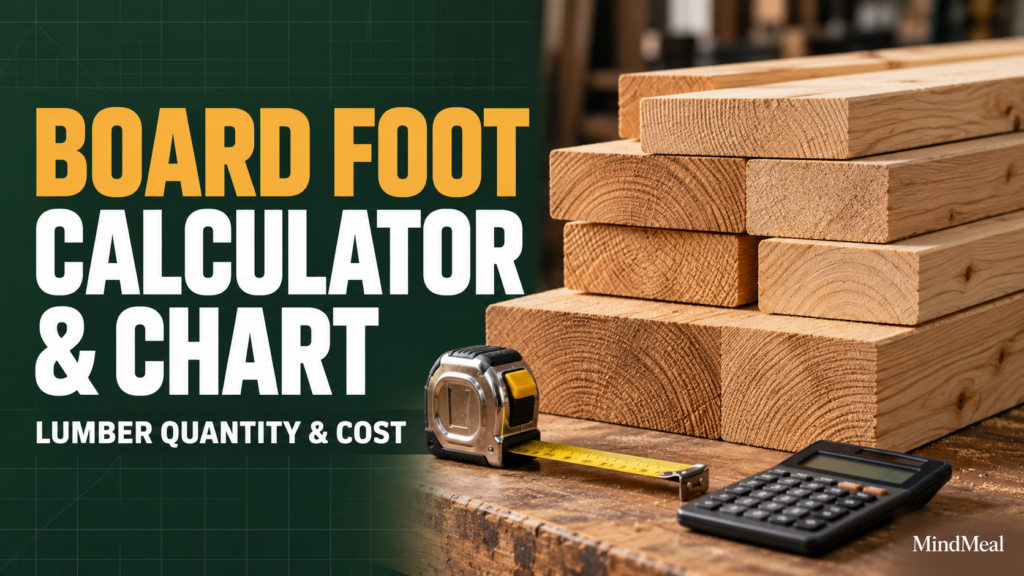
Use this Board Foot Calculator to estimate lumber quantity from thickness, width, length, and piece count. It supports US and metric inputs, keeps extra allowance separate, and can estimate material cost from a price per board foot or per thousand board feet.
Before entering dimensions, decide whether you need a supplier’s nominal lumber tally or the geometric volume of measured boards. Those are different measurement bases and can produce different answers for the same piece.
Board Foot Calculator
Enter decimals or fractions such as 1.5, 1 1/2, or 3/4. Do not add unit marks or commas. Presets load nominal thickness and width only; always enter the intended board length. The basis selector labels your calculation—it does not automatically resize a board.
What is a board foot?
One board foot (BF) represents 144 cubic inches: the volume of a piece 1 inch thick, 12 inches wide, and 12 inches long. It measures volume, not just length. Different rectangular shapes can contain the same number of board feet. [1]
Board foot formulas
| Input dimensions | Formula for one piece |
|---|---|
| Thickness and width in inches; length in feet | BF = thickness × width × length ÷ 12 |
| All three dimensions in inches | BF = thickness × width × length ÷ 144 |
| Thickness and width in mm; length in meters | BF = thickness × width × length ÷ 2,359.737216 |
Multiply the result by the number of identical pieces. With mixed sizes or lengths, calculate each group separately and add the unrounded group totals. The calculator uses the dimensions you enter without applying a trade rounding rule.
Nominal tally or measured volume: which should you use?
| Your purpose | Dimensions to enter | How to read the result |
|---|---|---|
| Estimate a nominal softwood lumber tally | Use the nominal thickness and width specified by the supplier, plus the relevant length. | A tally based on nominal dimensions; not the solid volume of dressed wood. |
| Calculate physical rectangular volume | Use the measured thickness, width, and length. | A geometric volume expressed in BF and cubic units. |
| Compare a hardwood quote | Use the thickness basis and measurements required by the supplier. | An unrounded estimate; the final trade tally may follow additional measurement rules. |
For illustration, a nominal 2 × 4 at 8 ft gives 2 × 4 × 8 ÷ 12 = 5.333333 BF. If a board instead measures 1.5 × 3.5 in at that same length, its geometric volume is 1.5 × 3.5 × 8 ÷ 12 = 3.5 BF. The formulas agree; the input dimensions differ. Do not replace nominal billing dimensions with measured dimensions unless the supplier uses that basis.
The preset list supplies nominal sizes only. If you select Measured rectangular dimensions, enter your measurements yourself. Changing the input units converts the current numeric dimensions; it does not select a different nominal product.
Board foot chart: common nominal lumber sizes
Values below are BF per piece, using nominal thickness × nominal width. Lengths are in feet. The chart is a calculated reference, not a stock-availability list or an actual-dimension chart. Values are rounded to two decimal places; multiply from the formula when you need a total.
| Nominal size | BF / linear ft | 8 ft | 10 ft | 12 ft | 14 ft | 16 ft |
|---|---|---|---|---|---|---|
| 1 × 2 | 0.17 | 1.33 | 1.67 | 2.00 | 2.33 | 2.67 |
| 1 × 3 | 0.25 | 2.00 | 2.50 | 3.00 | 3.50 | 4.00 |
| 1 × 4 | 0.33 | 2.67 | 3.33 | 4.00 | 4.67 | 5.33 |
| 1 × 6 | 0.50 | 4.00 | 5.00 | 6.00 | 7.00 | 8.00 |
| 1 × 8 | 0.67 | 5.33 | 6.67 | 8.00 | 9.33 | 10.67 |
| 1 × 10 | 0.83 | 6.67 | 8.33 | 10.00 | 11.67 | 13.33 |
| 1 × 12 | 1.00 | 8.00 | 10.00 | 12.00 | 14.00 | 16.00 |
| 2 × 2 | 0.33 | 2.67 | 3.33 | 4.00 | 4.67 | 5.33 |
| 2 × 3 | 0.50 | 4.00 | 5.00 | 6.00 | 7.00 | 8.00 |
| 2 × 4 | 0.67 | 5.33 | 6.67 | 8.00 | 9.33 | 10.67 |
| 2 × 6 | 1.00 | 8.00 | 10.00 | 12.00 | 14.00 | 16.00 |
| 2 × 8 | 1.33 | 10.67 | 13.33 | 16.00 | 18.67 | 21.33 |
| 2 × 10 | 1.67 | 13.33 | 16.67 | 20.00 | 23.33 | 26.67 |
| 2 × 12 | 2.00 | 16.00 | 20.00 | 24.00 | 28.00 | 32.00 |
| 3 × 4 | 1.00 | 8.00 | 10.00 | 12.00 | 14.00 | 16.00 |
| 4 × 4 | 1.33 | 10.67 | 13.33 | 16.00 | 18.67 | 21.33 |
| 4 × 6 | 2.00 | 16.00 | 20.00 | 24.00 | 28.00 | 32.00 |
| 4 × 8 | 2.67 | 21.33 | 26.67 | 32.00 | 37.33 | 42.67 |
| 6 × 6 | 3.00 | 24.00 | 30.00 | 36.00 | 42.00 | 48.00 |
| 6 × 8 | 4.00 | 32.00 | 40.00 | 48.00 | 56.00 | 64.00 |
| 8 × 8 | 5.33 | 42.67 | 53.33 | 64.00 | 74.67 | 85.33 |
Worked example: ten 2 × 6 boards, each 12 ft long
Using nominal thickness and width, one piece contains 2 × 6 × 12 ÷ 12 = 12 BF. Ten pieces total 120 BF. If you choose an extra allowance of 10%, add 12 BF to obtain a planning total of 132 BF. The 10% is an example, not a universal recommendation.
At an illustrative price of $2.50/BF, the base material estimate is $300 and the allowance adds $30, giving $330. This is an assumed price for demonstrating arithmetic, not a market quote. The calculator also accepts $2,500 per MBF as the same rate—enter 2500 without a comma.
A planning quantity in BF is not automatically a purchasable cut list. Actual ordering may require whole boards, standard stock lengths, and allowances for saw cuts, defects, trimming, or matching grain. The calculator does not round up the number of pieces or optimize cuts.
Metric example: 25 mm × 150 mm × 3 m
For one rectangular board measured at these dimensions, the volume is 0.025 × 0.150 × 3 = 0.01125 m³. Dividing by 0.002359737216 m³/BF gives approximately 4.767480 BF. Ten such boards contain approximately 47.674800 BF, before any extra allowance.
| Volume conversion | Value |
|---|---|
| 1 BF | 144 in³ = 1/12 ft³ |
| 1 BF | 0.002359737216 m³ |
| 1 m³ | Approximately 423.776001 BF |
| 1 MBF | 1,000 BF |
Cubic equivalents retain the basis of your input dimensions. When nominal sizes are used, the cubic result is a nominal volume equivalent, not a measurement of the delivered wood. When measured rectangular dimensions are used, it is a geometric volume estimate.
Hardwood thickness: what do 4/4 and 8/4 mean?
Hardwood rough thickness is commonly described in quarters of an inch. For example, 4/4 denotes 1 inch and 8/4 denotes 2 inches. These labels do not guarantee the finished thickness after surfacing. [2]
| Quarter designation | Thickness represented by the designation |
|---|---|
| 4/4 | 1 in |
| 5/4 | 1.25 in |
| 6/4 | 1.5 in |
| 8/4 | 2 in |
You may type 5/4 in the thickness field when inches are selected, and it will evaluate to 1.25. Confirm the supplier’s tally basis before pricing. Hardwood surface-measure rounding, minimum tally thickness, deductions, and dry-versus-green tally rules are not implemented by this simple volume calculator. AHEC’s measurement guide explains why commercial measurement can involve more than raw multiplication. [2]
Extra allowance is not the same as yield loss
This tool adds an allowance to the base quantity: planning BF = base BF × (1 + allowance/100). A 10% allowance on 120 BF produces 132 BF. If instead you expect to lose 10% of purchased stock and need 120 BF usable, the different calculation is 120 ÷ 0.90 = 133.333333 BF. Select an allowance appropriate to the actual cut list and material quality.
Board feet, linear feet, and square feet
Linear feet measure length. Square feet measure area. Board feet measure volume. To convert from linear feet to BF, you must know thickness and width. To convert from square feet of solid rectangular boards to BF, you must know thickness: BF = area in ft² × thickness in inches. This is a volume relationship, not installed coverage accounting for gaps, overlaps, or waste.
Frequently asked questions
How many board feet are in a 2 × 4 × 8?
Using nominal 2 × 4 dimensions and an 8 ft length, the result is 5⅓ BF per piece. Enter measured dimensions if you want the actual rectangular volume instead.
Can I use this to estimate logs or standing trees?
No. The calculator treats each piece as a rectangular board. Log scaling and standing-tree estimates use different methods, including allowances related to sawing and log shape. [3]
Can I calculate several different board sizes?
Calculate one group of identical pieces at a time, then add each base BF subtotal. Apply a common allowance to the combined base total, or retain separate allowances where appropriate.
Why does my supplier’s invoice differ?
Check nominal versus measured dimensions, the hardwood tally method, rounded measurements, minimum thickness rules, stock lengths, and whether the price is per BF, per MBF, per linear foot, or per piece.
Does the cost include delivery and tax?
No. It multiplies the estimated BF quantity by your entered rate. Taxes, delivery, surfacing, grading premiums, and other charges are not included. Prices are labeled USD; no exchange-rate conversion is performed.
Sources and calculation scope
[1] Penn State Extension — Valuing Standing Timber: board-foot definition and lumber example.
[2] American Hardwood Export Council — Grading sawn lumber: Measurement.
[3] University of Missouri Extension, G5050 — How to Measure Trees and Logs.
Reviewed October 19, 2026. Formulas and chart values are calculated from the rectangular-volume definition of a board foot. This page estimates quantity and cost; it does not grade lumber, establish invoice rules, or check structural suitability.
MindCore