Fraction to Decimal Inches Chart: Fractions, Decimals, and mm
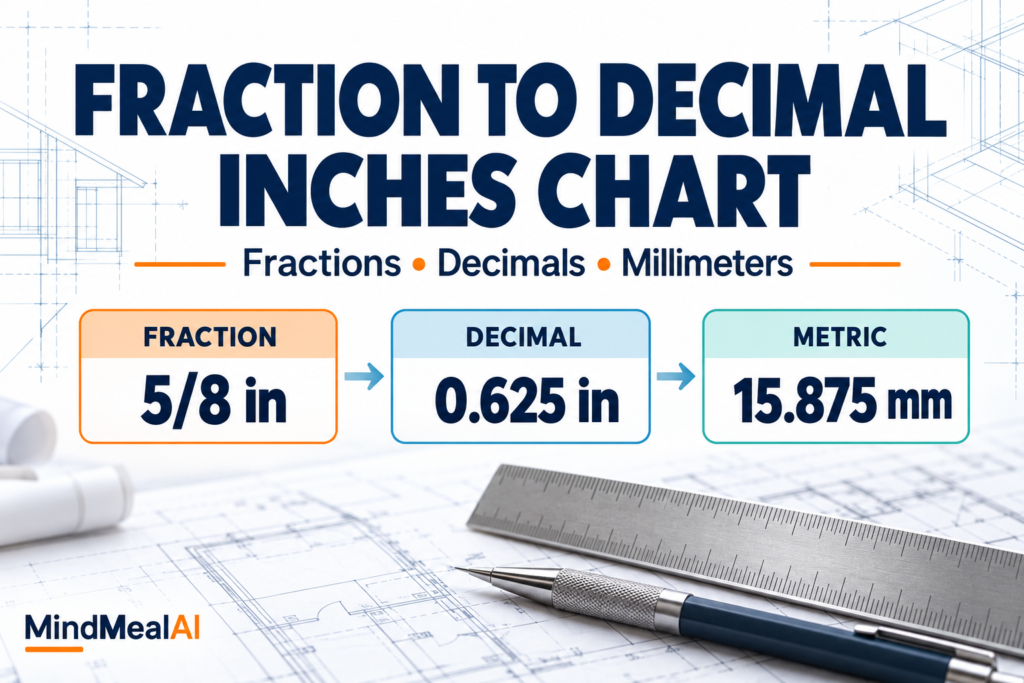
This fraction to decimal inches chart helps you read drawing dimensions, compare material thicknesses, and transfer fractional inch values into software that expects decimals. Find the fraction you need and read its decimal inch and millimeter equivalents on the same row.
Fraction to Decimal Inches Chart
Look up fractional inches, exact decimal inches, and exact millimeters. The complete table covers 1/64 inch through 1 inch.
64 exact conversions are listed below. Search controls appear when JavaScript is available.
| Fraction (in) | Decimal (in) | Millimeters (mm) |
|---|---|---|
| 1/64 | 0.015625 | 0.396875 |
| 1/32 | 0.031250 | 0.793750 |
| 3/64 | 0.046875 | 1.190625 |
| 1/16 | 0.062500 | 1.587500 |
| 5/64 | 0.078125 | 1.984375 |
| 3/32 | 0.093750 | 2.381250 |
| 7/64 | 0.109375 | 2.778125 |
| 1/8 | 0.125000 | 3.175000 |
| 9/64 | 0.140625 | 3.571875 |
| 5/32 | 0.156250 | 3.968750 |
| 11/64 | 0.171875 | 4.365625 |
| 3/16 | 0.187500 | 4.762500 |
| 13/64 | 0.203125 | 5.159375 |
| 7/32 | 0.218750 | 5.556250 |
| 15/64 | 0.234375 | 5.953125 |
| 1/4 | 0.250000 | 6.350000 |
| 17/64 | 0.265625 | 6.746875 |
| 9/32 | 0.281250 | 7.143750 |
| 19/64 | 0.296875 | 7.540625 |
| 5/16 | 0.312500 | 7.937500 |
| 21/64 | 0.328125 | 8.334375 |
| 11/32 | 0.343750 | 8.731250 |
| 23/64 | 0.359375 | 9.128125 |
| 3/8 | 0.375000 | 9.525000 |
| 25/64 | 0.390625 | 9.921875 |
| 13/32 | 0.406250 | 10.318750 |
| 27/64 | 0.421875 | 10.715625 |
| 7/16 | 0.437500 | 11.112500 |
| 29/64 | 0.453125 | 11.509375 |
| 15/32 | 0.468750 | 11.906250 |
| 31/64 | 0.484375 | 12.303125 |
| 1/2 | 0.500000 | 12.700000 |
| 33/64 | 0.515625 | 13.096875 |
| 17/32 | 0.531250 | 13.493750 |
| 35/64 | 0.546875 | 13.890625 |
| 9/16 | 0.562500 | 14.287500 |
| 37/64 | 0.578125 | 14.684375 |
| 19/32 | 0.593750 | 15.081250 |
| 39/64 | 0.609375 | 15.478125 |
| 5/8 | 0.625000 | 15.875000 |
| 41/64 | 0.640625 | 16.271875 |
| 21/32 | 0.656250 | 16.668750 |
| 43/64 | 0.671875 | 17.065625 |
| 11/16 | 0.687500 | 17.462500 |
| 45/64 | 0.703125 | 17.859375 |
| 23/32 | 0.718750 | 18.256250 |
| 47/64 | 0.734375 | 18.653125 |
| 3/4 | 0.750000 | 19.050000 |
| 49/64 | 0.765625 | 19.446875 |
| 25/32 | 0.781250 | 19.843750 |
| 51/64 | 0.796875 | 20.240625 |
| 13/16 | 0.812500 | 20.637500 |
| 53/64 | 0.828125 | 21.034375 |
| 27/32 | 0.843750 | 21.431250 |
| 55/64 | 0.859375 | 21.828125 |
| 7/8 | 0.875000 | 22.225000 |
| 57/64 | 0.890625 | 22.621875 |
| 29/32 | 0.906250 | 23.018750 |
| 59/64 | 0.921875 | 23.415625 |
| 15/16 | 0.937500 | 23.812500 |
| 61/64 | 0.953125 | 24.209375 |
| 31/32 | 0.968750 | 24.606250 |
| 63/64 | 0.984375 | 25.003125 |
| 1 | 1.000000 | 25.400000 |
How to Use the Chart
- Choose the table spacing. Use 1/16 inch for a shorter reference, 1/32 inch for finer increments, or 1/64 inch for the complete list.
- Search for a specific size. Enter 3/32, 5/8, or a decimal such as 0.625. Search always checks the complete 64-entry table.
- Read across the row. The columns show fractional inches, decimal inches, and millimeters.
- Copy the visible rows if you want to paste the values into a spreadsheet or your notes.
The table lists increments within one inch. For larger mixed dimensions, separate the whole inches from the fractional part, or use the Feet and Inches Calculator linked below. The table remains readable even if JavaScript is unavailable.
Three Quick Conversions
- 1/16 inch = 0.0625 inch = 1.5875 mm.
- 3/32 inch = 0.09375 inch = 2.38125 mm.
- 5/8 inch = 0.625 inch = 15.875 mm.
Trailing zeros do not change the value. The table displays 0.625000 and 15.875000 so each column has a consistent format; these equal 0.625 and 15.875.
How to Convert a Fraction to Decimal Inches
Divide the numerator, the top number, by the denominator, the bottom number:
Decimal inches = numerator ÷ denominator
For 3/32 inch, calculate 3 ÷ 32 = 0.09375 inch. For 5/8 inch, calculate 5 ÷ 8 = 0.625 inch. Both values describe the original inch dimension in decimal form.
Why 10/16 and 5/8 Give the Same Result
Equivalent fractions describe the same length. Dividing both 10 and 16 by 2 simplifies 10/16 to 5/8. The search recognizes that equivalence and displays the reduced fraction used in the table.
How to Convert Inches to Millimeters
One inch equals exactly 25.4 millimeters. Multiply the decimal inch value by 25.4:
Millimeters = decimal inches × 25.4
For 5/8 inch: 0.625 × 25.4 = 15.875 mm. For 3/32 inch: 0.09375 × 25.4 = 2.38125 mm. Convert from the full decimal inch value before rounding the final result.
Example: Reading a Plate Thickness
A drawing specifies a 3/8-inch plate. The chart gives 0.375 inch and 9.525 mm. These are two equivalent ways to express the specified thickness.
This distinction matters when comparing a U.S. drawing with a metric supplier catalog. A nearby stock thickness may be practical to source, but its suitability is a separate decision from the mathematical conversion.
Example: Converting 1-5/8 Inches
A mixed number combines whole inches and a fraction. First convert the fractional part: 5/8 = 0.625. Then add the whole inch:
1 + 0.625 = 1.625 inches
1.625 × 25.4 = 41.275 mm
The one-inch table shows the fractional portion only. Do not enter 1-5/8 in the table search; use 5/8 to look up its fractional part. For full mixed-number calculations, use the separate Feet and Inches Calculator.
How to Read 1/16, 1/32, and 1/64 Increments
Each step divides one inch into equal parts. A 1/16-inch increment is four times a 1/64-inch increment. A 1/32-inch increment is twice a 1/64-inch increment.
That is why the 1/16-inch view contains 1/16, 1/8, 3/16, and other sixteenth-inch positions, while 3/32 appears in the finer views. Searching for 3/32 finds it directly even when the selected table spacing is 1/16 inch.
Exact Conversion vs. Rounded Size
All fractions in this chart have denominators that divide 64. Their decimal inch values terminate within six decimal places, and their millimeter values also fit within six decimal places. The displayed table values are exact mathematical conversions.
Rounding a dimension for a drawing is a separate step. For example, 5/8 inch is exactly 15.875 mm; rounding to a whole millimeter gives 16 mm. The difference is 0.125 mm. Whether that rounding is acceptable depends on the specified tolerance and purpose of the dimension.
Frequently Asked Questions
Is 0.625 inch the same as 5/8 inch?
Yes. They are exactly the same length, and both equal 15.875 mm.
Why is 1/3 inch not in this table?
This chart covers 1/64-inch increments, including their simplified fractions. One-third inch is not one of those increments. Its decimal representation repeats, unlike the listed values.
Is this also a drill-bit size chart?
It converts fractional dimensions, but it does not list number or letter drill sizes, recommend hole clearances, or determine a tap-drill size. Those require the appropriate separate reference.
Can I use decimal inches as decimal feet?
No. They have different units. To convert total inches to feet, divide by 12. For example, 6 inches is 0.5 foot.
Related Tables and Calculators
- Feet and Inches Calculator — add, subtract, or convert complete lengths.
- Steel Plate Weight Calculator — use a plate’s dimensions to estimate its weight.
- W-Beam Dimensions and Properties Table — look up section dimensions.
Reference: NIST, SI Units—Length. Conversion basis: 1 inch = 25.4 mm exactly. Table values are calculated from the listed fractions; no product tolerances or nominal material substitutions are implied.
MindCore