Steel Beam Weight Calculator: W-Beam Weight by Size and Length
This steel beam weight calculator estimates the weight of one beam and a group of identical beams from section size, overall length, and quantity. It supports both imperial and metric input and displays pounds and kilograms together.
Use it for preliminary material takeoffs and drawing quantity checks. It calculates the beam’s own weight, not the load it can support.
Steel Beam Weight Calculator
Search 132 listed U.S. W-shapes, or enter a verified unit weight. Use imperial or metric lengths and view both lb and kg.
How to Use the Calculator
- Search and select a size. Enter W12 to narrow the list or W12x26 for a specific section. Select the actual size from the dropdown.
- Choose a length format. Enter feet and additional inches in separate fields, or select decimal feet, total inches, meters, or millimeters.
- Enter the quantity. All beams in that calculation must have the same size and length.
- Calculate. Read the weight of one beam and the full group in both lb and kg.
For a section outside the list, choose Custom: enter verified unit weight. Select lb/ft or kg/m before entering the value. The calculator does not identify or validate a section from that number alone.
What Does W12×26 Mean?
In a U.S. W-shape designation, W identifies a wide-flange section, 12 indicates its nominal depth in inches, and 26 gives the nominal weight in pounds per foot. The actual depth must be read from a section table.
Weight Calculation Formulas
One beam, lb = unit weight, lb/ft × length, ft
One beam, kg = unit mass, kg/m × length, m
Group total = one beam × quantity
The tool uses 1 ft = 0.3048 m and 1 lb = 0.45359237 kg. Listed W-shape metric values are converted from the nominal lb/ft values. Their displayed kg/m values are rounded to two decimals; calculations use the unrounded conversion. For custom inputs, the precision is limited by the unit weight you provide.
Example 1: Three 20-Foot W12×26 Beams
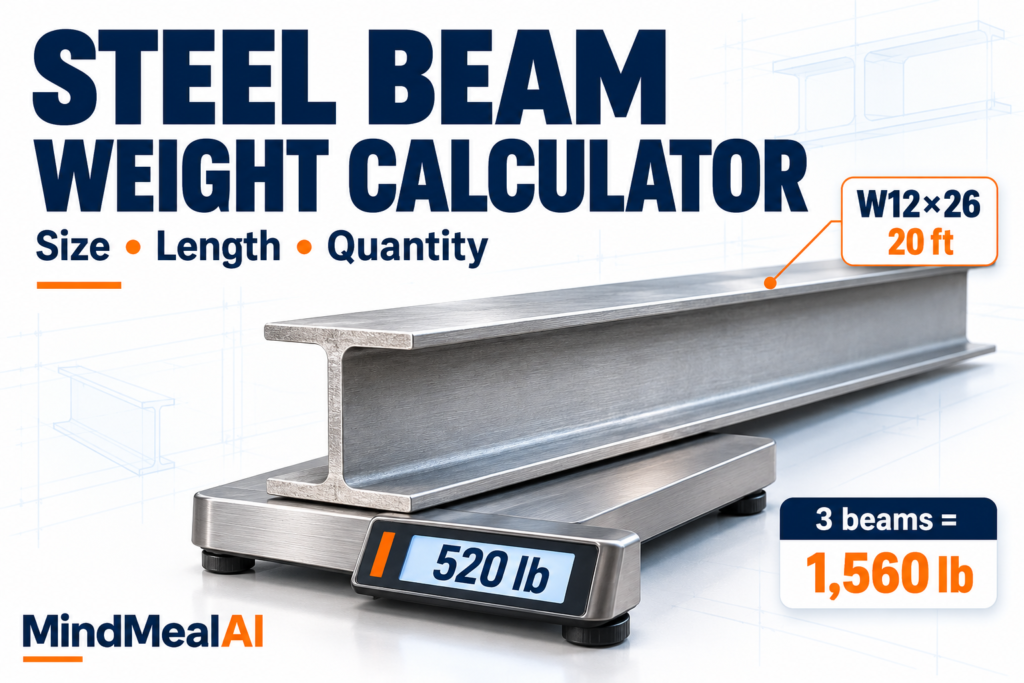
- One beam: 26 lb/ft × 20 ft = 520 lb.
- Three beams: 520 × 3 = 1,560 lb.
- Converted total: 707.60 kg.
In metric mode, entering 6.096 m or 6096 mm for each beam produces the same result. This is a useful check when a drawing and a takeoff spreadsheet use different units.
Example 2: Four 6-Meter W12×26 Beams
Select W12×26, choose Meters, enter 6, and set the quantity to 4. Each beam weighs approximately 232.15 kg; the group weighs 928.61 kg, or 2,047.24 lb. A 6-meter beam is shorter than a 20-foot beam, so these totals are not interchangeable.
Example 3: A Verified Metric Unit Weight
Suppose a supplier’s section table gives a unit mass of 40 kg/m. Select custom input, choose kg/m, and enter 40. At 6 m each and a quantity of 3, the result is 240 kg per beam and 720 kg total. For a regional profile not listed here, use its own verified unit mass; do not substitute a similarly sized W-shape.
Selected 20-Foot Beam Weights
| Section | lb/ft | kg/m, rounded | One 20-ft beam |
|---|---|---|---|
| W8×18 | 18 | 26.79 | 360 lb |
| W10×19 | 19 | 28.28 | 380 lb |
| W12×26 | 26 | 38.69 | 520 lb |
| W14×34 | 34 | 50.60 | 680 lb |
| W16×40 | 40 | 59.53 | 800 lb |
This is a weight comparison, not a structural capacity comparison.
Choose the Right Length for Your Takeoff
A grid-to-grid dimension or clear span may differ from the member’s overall length because of bearing, overhangs, and connection geometry. Use the detailed member length for a finished-beam estimate. Use purchased stock length when estimating purchased steel.
For example, a finished 18-foot piece cut from a purchased 20-foot beam has a different finished weight from the purchased stock weight. Keep offcuts and other material allowances separate so the estimate remains understandable.
Different Sizes or Lengths Need Separate Calculations
Group members by section and length. Three 20-foot W12×26 beams weigh 1,560 lb. Two 15-foot W12×26 beams weigh 780 lb. Their combined nominal weight is 2,340 lb. Record each group beside its beam mark before adding the totals.
What Is Included—and What Is Separate?
The result is a nominal rolled-beam estimate. It does not add shear plates, end plates, stiffeners, bolts, weld metal, studs, coatings, or packaging. It does not deduct holes or copes. Calculate attachments separately before estimating an assembly’s weight.
Measured finished weight can differ from a nominal calculation. Confirm the required weight basis with the supplier or fabricator for shipping and handling. Lifting arrangements require additional information beyond nominal beam weight.
Frequently Asked Questions
Does the dropdown contain every W-shape?
No. It contains 132 entries from the site’s W-beam reference table, spanning W4 through W27. It is not the complete AISC catalog or a statement of current supplier availability. Use the custom option for an unlisted section with a verified unit weight.
Can different beam sizes weigh the same?
Yes. W12×26 and W16×26 both have a nominal weight of 26 lb/ft. At equal lengths, their calculated weight is the same, but their dimensions and structural properties differ.
Does using kg/m change the beam size?
No. Unit conversion describes the same member in another system. Regional section designations and actual geometry must still be checked separately.
Can the calculator choose a safe beam?
No. Span, loading, bracing, section properties, steel grade, supports, and connections affect capacity. Weight alone cannot establish suitability.
Related Tools
Reference basis: the site’s 132-entry W-beam table for the selection list; AISC W-shape naming convention for nominal lb/ft; standard international-foot and pound-to-kilogram conversions. This tool provides nominal material quantities, not structural design or supplier stock verification.
MindCore