HSS vs Pipe: Size Designations and Key Differences
When comparing HSS vs Pipe, the first thing to check is the designation—not just the shape. Two round steel members can look similar while having different material specifications, dimensional tolerances, and design properties.
For anyone reading structural drawings, the practical question is: What product does this callout actually specify?
This guide focuses on U.S. structural steel terminology and customary-unit designations.
HSS vs Pipe at a Glance
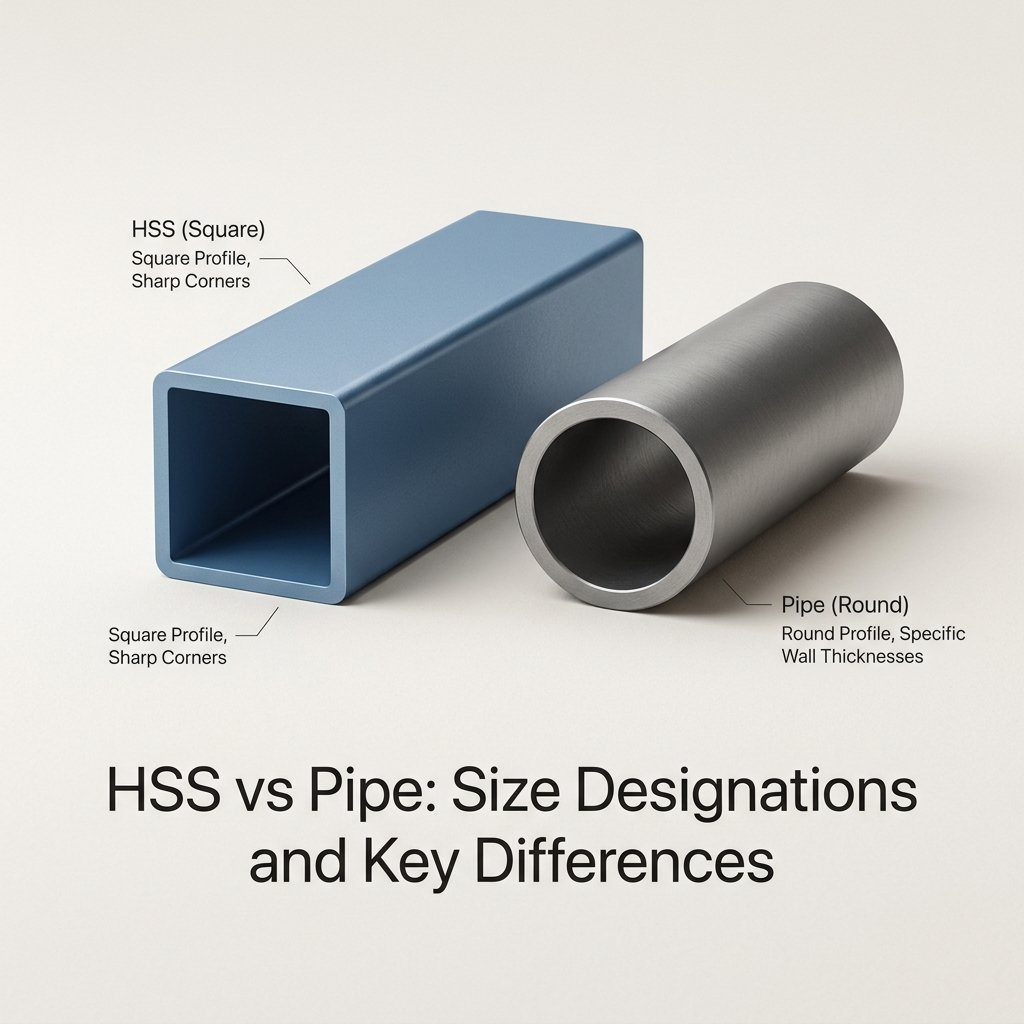
HSS stands for Hollow Structural Section. It includes square, rectangular, and round structural tubing. In this comparison, “pipe” primarily refers to ASTM A53 steel pipe, rather than every product described as pipe.
| Item | HSS | ASTM A53 Steel Pipe |
|---|---|---|
| Common shapes | Square, rectangular, and round | Round |
| Typical specification | ASTM A500 or ASTM A1085 | ASTM A53 |
| Size description | Outside dimensions and nominal wall thickness | Nominal Pipe Size (NPS), plus a wall-thickness designation |
| Common application | Building columns, braces, beams, and trusses | Mechanical and pressure applications; some structural uses |
Round does not automatically mean pipe, and square does not automatically establish a structural material specification. Check the drawing notes and material requirements as well as the section label.
How to Read an HSS Designation
Consider HSS6×4×1/4:
- 6 in: larger specified outside dimension.
- 4 in: smaller specified outside dimension.
- 1/4 in: nominal wall thickness.
These dimensions do not describe the clear opening inside the member. Rectangular HSS also has rounded corners, which matter when fitting plates or other components inside it.
For round HSS, a designation such as HSS8.625×0.322 identifies a specified outside diameter of 8.625 inches and a nominal wall thickness of 0.322 inch.
These are specified dimensions, not a promise that every measured dimension is exact. Manufacturing tolerances still apply.
How to Read a Pipe Designation
Pipe uses Nominal Pipe Size, usually abbreviated NPS. The nominal size does not always equal the outside diameter.
For example, an NPS 8 standard-weight pipe has an outside diameter of 8.625 inches, not 8 inches. Its nominal wall thickness is 0.322 inch.
A schedule number identifies a wall-thickness series. It is not a thickness in inches or millimeters, and a given schedule does not have one fixed thickness across all pipe sizes. Look up the combination of pipe size and wall designation.
This distinction matters when laying out a sleeve, opening, support plate, or clearance around a round member.
Same Dimensions Do Not Mean the Same Product
Compare these two callouts:
| Callout | Specified Outside Diameter | Nominal Wall Thickness |
|---|---|---|
| HSS8.625×0.322 | 8.625 in | 0.322 in |
| NPS 8 standard-weight pipe | 8.625 in | 0.322 in |
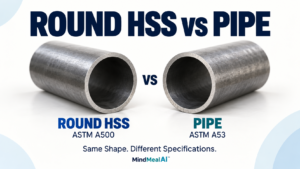
The listed geometry matches, but the callouts do not establish identical material requirements. An ASTM A500 HSS member and an ASTM A53 pipe are supplied under different specifications.
Do not approve a substitution based on matching dimensions alone. The engineer must review the specified material, grade, applicable design properties, and connection requirements.
Nominal Wall Thickness and Design Thickness
The wall thickness written in an HSS label is the nominal thickness. The thickness used for engineering calculations may differ, depending on the product specification and applicable design provisions.
When consulting a section-properties table, check its material assumptions and whether it distinguishes nominal thickness from design thickness. Avoid applying an additional reduction to properties that already include the required adjustment.
For drafting, preserve the specified member designation. Do not replace its nominal thickness with a calculated design thickness in the plan label.
What to Check on Structural Drawings
A useful review follows the member from the plan to its supporting details:
- Match the member mark. Confirm the plan, schedule, and detail refer to the same section.
- Read the material notes. Identify the ASTM specification and grade.
- Check the actual outside size. Do not use NPS as the measured diameter.
- Review connection fit. Check clearances, plate geometry, and access for fabrication.
- Confirm availability. Verify the required size and material with the supplier before accepting a change.
For example, placing an 8-inch opening around an NPS 8 pipe would ignore its 8.625-inch outside diameter—even before allowing clearance.
Common Questions
Is round HSS the same as pipe?
Not automatically. Similar outside dimensions can occur in both products, but their designations and specifications must still be checked.
Can pipe be used structurally?
Yes, where the applicable specification and structural design permit it. That does not make any available pipe a direct replacement for a specified HSS member.
Is HSS always stronger?
That statement is too broad. Member capacity depends on material grade, section dimensions, length, restraint, loading, and connections—not the name alone.
Key Takeaways
- HSS can be square, rectangular, or round.
- HSS labels describe outside dimensions and nominal wall thickness.
- NPS is a nominal designation; check the actual pipe diameter.
- Matching geometry does not establish an acceptable substitution.
- Read the section label together with the material notes and connection details.
Related reading: HSS Steel Sizes and Properties Table
MindCore