When Do Steel Beams Need Web Stiffeners?
STRUCTURAL STEEL · PRACTICAL DESIGN & DETAILING
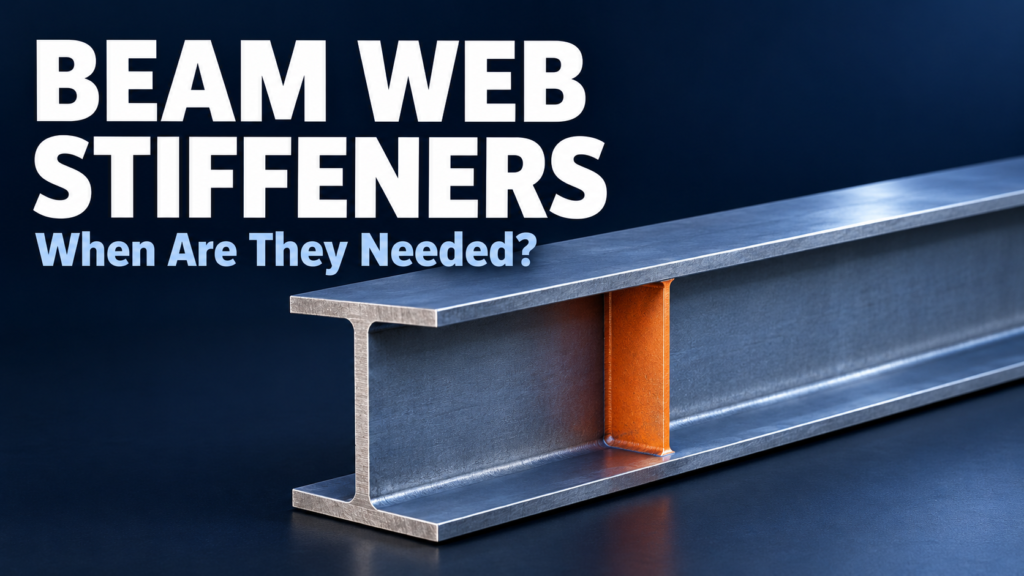
Beam web stiffeners are plates added to help a steel beam handle a local force or control web instability. They often appear near supports and concentrated loads, but they are not required simply because a beam is deep or carries a heavy load.
This guide explains the difference between bearing and shear stiffeners, what engineers check, and what a drafter should confirm before issuing a drawing.
What are beam web stiffeners?
A W-shaped beam has two flanges connected by a web. A transverse stiffener is a plate oriented across the web depth and projecting out from the web surface. It may be provided on one side or as a pair, depending on its purpose and design.
A doubler plate is different: it lies parallel to the web and reinforces a region of it. The two details should not be substituted merely because both add steel near a connection.
When do steel beams need web stiffeners?
| Situation | Why the web needs attention | Design question |
|---|---|---|
| Beam bearing on a seat or cap plate | The support reaction enters through a limited flange length. | Can the unstiffened web carry the reaction at that location? |
| Post or equipment load on a flange | A concentrated force creates a local demand. | Are local flange and web strengths adequate? |
| Deep girder with a slender web | Web shear buckling can control. | Does the shear design require intermediate stiffeners? |
| Connection or brace attachment | A defined force must enter or restrain the member. | What reinforcement and restraint does that specific detail require? |
These are locations to investigate, not an automatic stiffener schedule. A beam with adequate unstiffened strength may need no local reinforcement. Another beam of similar depth may need it because its reaction, web thickness, bearing length, or distance from the end differs.
Bearing stiffeners and shear stiffeners do different jobs
Bearing stiffeners: concentrated force transfer
Bearing stiffeners help carry a concentrated compressive force at a support or load point. Their alignment with the loaded region matters. The engineer also determines how force enters the plates and reaches the connected web and flange.
Intermediate transverse stiffeners: web panel behavior
Intermediate stiffeners can improve the shear behavior of a slender web by defining and restraining web panels. Spacing, plate stiffness, and the selected shear design method matter. A regular series of stiffeners in a plate girder serves a different purpose from one reinforced bearing location.
Which local failure modes do engineers check?
AISC 360 addresses flanges and webs subject to concentrated forces in Section J10. The applicable checks depend on force direction, location, geometry, and restraint; not every check applies to every detail.
- Web local yielding: the web yields in the local force-transfer region.
- Web local crippling: localized instability near a flange under compression.
- Web sidesway buckling: instability associated with relative lateral movement of the flanges under certain concentrated compression conditions.
- Web compression buckling: buckling associated with opposing compressive forces at the flanges.
- Flange local bending: local flange bending associated with applicable concentrated tensile forces.
Web shear strength is a separate check under Chapter G. Passing a beam bending or deflection check does not establish that a local bearing region is adequate.
A practical example: a beam bearing on an HSS column
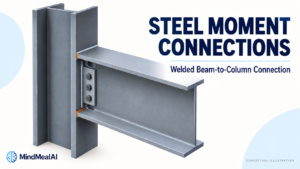
Consider a W-beam sitting on a cap plate welded to the top of an HSS column. The beam reaction reaches the column through the beam’s lower flange and the cap plate.
Beam stiffeners may be part of this detail, but checking them alone does not verify the connection. The cap plate, HSS walls, welds, and any bolts also need the checks associated with the forces they carry. Alignment and plate thickness affect how the load spreads into the supporting member.
A beam that continues over a column and a beam that terminates there can have different reactions and local conditions. Confirm which condition the detail represents before reusing it. Bolts through a bottom flange do not, by themselves, establish a moment connection.
What should the drawing clearly show?
A note saying only “provide stiffeners” leaves important decisions unresolved. Coordinate the following with the structural engineer and fabricator:
- Location: tie the plates to the actual support, load, or connection line.
- Quantity: state whether one plate or a pair is required at each location.
- Plate size and material: identify thickness, width, extent, and grade.
- End condition: distinguish specified bearing contact from a clearance or a welded force-transfer detail.
- Welds: identify the connected surfaces and required weld size and extent.
- Fit and access: coordinate flange-to-web fillet clearances, bolts, weld access, and nearby framing.
- Consistency: match the plan, section, schedule, and shop detail.
For a drafting review, a useful first question is: Can someone trace the force through every part shown in this detail? If the reaction line and stiffener location do not match, ask whether that offset was included in the design.
Common mistakes to avoid
- Choosing a plate from beam depth alone. There is no universal stiffener thickness that works for every W-shape.
- Assuming a short plate solves every local problem. Partial-depth reinforcement must suit the governing limit state; research has documented crippling in webs with partial-depth stiffeners.
- Treating a full-depth stiffener as automatic lateral bracing. A plate inside the section does not itself supply an external restraint against overall beam movement.
- Adding plates to solve excessive deflection. Local stiffeners generally do not provide the span-wide stiffness change needed for a deflection problem.
- Changing plate extent or welds in the field. A seemingly small change can alter the intended force transfer.
Frequently asked questions
Does every steel beam need stiffeners at its supports?
No. The support configuration, reaction, bearing length, and applicable strength and stability checks determine the need. A bearing support and a web-connected beam end should not automatically receive the same detail.
Must every stiffener extend the full web depth?
No single extent fits every purpose. Some applications require full-depth reinforcement; others allow a different configuration. Use the requirements for the actual limit state and connection rather than shortening a detail by eye.
Could a different beam or bearing detail avoid stiffeners?
Sometimes. A different section or a revised bearing arrangement may resolve the controlling check. Compare the entire connection and fabrication cost, then verify the revised design.
Key takeaways
- Start with the force and the local condition, not a standard-looking plate.
- Separate concentrated-force reinforcement from web shear stiffening.
- Check the surrounding connection as well as the stiffener.
- Show enough information for the intended detail to be fabricated correctly.
Scope: educational overview for junior engineers, students, and structural drafters. All figures are original, schematic, and not to scale. They omit fabrication details and are not construction drawings. Apply the governing project code edition and the engineer’s design.
Technical references
- AISC, Specification for Structural Steel Buildings, ANSI/AISC 360-22: Chapter G and Section J10. Use the edition adopted for the project.
- AISC, Steel Construction Manual, 16th Edition.
- Steel Tube Institute, “HSS Limit States in Cap Plate Connections,” Cathleen Jacinto. This resource discusses the 2016 Specification.
- Salkar, Salkar, and Davids (2015), “Crippling of Webs with Partial Depth Stiffeners under Patch Loading,” AISC Engineering Journal, 52(4), 221–232.
- AISC, “Top 10 FAQs about the Manual & 2016 Specification—Part One,” discussion of transverse stiffeners and bracing.
MindCore