Lumber Actual Size Chart: Nominal vs. Actual Dimensions in Inches and mm
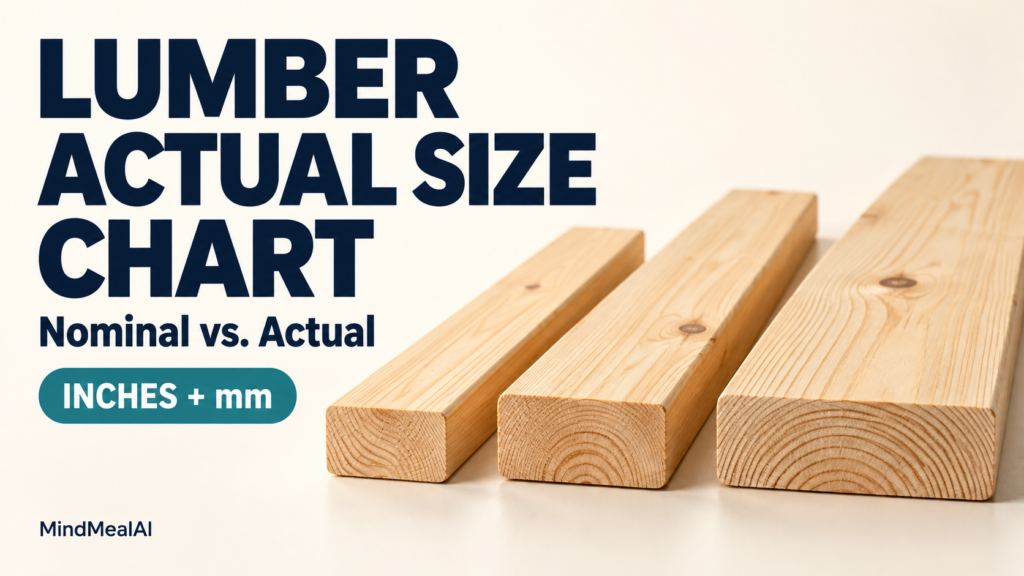
A standard dry, surfaced 2×4 has a minimum dressed cross section of 1½ × 3½ inches at manufacture, rather than its nominal 2 × 4 designation. The same distinction matters when you draw a wall section, check a hanger, or work out a built-up member’s width. This Lumber Actual Size Chart compares nominal labels with minimum dressed dimensions in inches and millimeters.
Quick Lumber Size Lookup
Select a nominal size and the condition at surfacing. The lookup covers 35 selected sizes, including 1× boards, 2× / 3× / 4× dimension lumber, and larger timbers. It is not the full PS 20 size schedule or a lumber-strength calculator.
Use General Table 3 sizes for standard products such as Douglas Fir–Larch, Hem–Fir, Spruce–Pine–Fir, and Southern Pine, subject to the applicable grading rules. Green sizes for the three named cedar/redwood species are excluded from this lookup because PS 20 Table 5 modifies their widths.
Interactive lookup is loading. The reference tables below are always available.
Decimal inches: 1.5 × 3.5 in
Minimum dressed size at manufacture. Dry lumber under 5 in nominal thickness: maximum 19% moisture content.
Why Is a 2×4 Smaller Than Its Name?
Nominal size is the trade designation used to identify a lumber size. Dressed size is the finished cross section after surfacing. Drying and machining affect the dimensions, but the nominal label is not a measurement of the board in your hand. It also does not guarantee that an earlier rough board measured exactly 2 × 4 inches.
Dry Lumber Actual Size Chart: Inches and Millimeters
Read each size as thickness × width. Metric values below are conversions of the inch dimensions using 1 in = 25.4 mm, rounded to two decimal places when needed. They are not separate national metric sizes. For example, 19.05 mm is the exact conversion of 3/4 in; the PS 20 metric table may show a rounded value such as 19.1 mm.
1× Boards
| Nominal size (in) | Minimum dressed dry (in) | Converted size (mm) |
|---|---|---|
| 1 × 2 | 3/4 × 1 1/2 | 19.05 × 38.1 |
| 1 × 3 | 3/4 × 2 1/2 | 19.05 × 63.5 |
| 1 × 4 | 3/4 × 3 1/2 | 19.05 × 88.9 |
| 1 × 6 | 3/4 × 5 1/2 | 19.05 × 139.7 |
| 1 × 8 | 3/4 × 7 1/4 | 19.05 × 184.15 |
| 1 × 10 | 3/4 × 9 1/4 | 19.05 × 234.95 |
| 1 × 12 | 3/4 × 11 1/4 | 19.05 × 285.75 |
2×, 3×, and 4× Dimension Lumber
| Nominal size (in) | Minimum dressed dry (in) | Converted size (mm) |
|---|---|---|
| 2 × 2 | 1 1/2 × 1 1/2 | 38.1 × 38.1 |
| 2 × 3 | 1 1/2 × 2 1/2 | 38.1 × 63.5 |
| 2 × 4 | 1 1/2 × 3 1/2 | 38.1 × 88.9 |
| 2 × 6 | 1 1/2 × 5 1/2 | 38.1 × 139.7 |
| 2 × 8 | 1 1/2 × 7 1/4 | 38.1 × 184.15 |
| 2 × 10 | 1 1/2 × 9 1/4 | 38.1 × 234.95 |
| 2 × 12 | 1 1/2 × 11 1/4 | 38.1 × 285.75 |
| 2 × 14 | 1 1/2 × 13 1/4 | 38.1 × 336.55 |
| 2 × 16 | 1 1/2 × 15 1/4 | 38.1 × 387.35 |
| 3 × 4 | 2 1/2 × 3 1/2 | 63.5 × 88.9 |
| 3 × 6 | 2 1/2 × 5 1/2 | 63.5 × 139.7 |
| 3 × 8 | 2 1/2 × 7 1/4 | 63.5 × 184.15 |
| 3 × 10 | 2 1/2 × 9 1/4 | 63.5 × 234.95 |
| 3 × 12 | 2 1/2 × 11 1/4 | 63.5 × 285.75 |
| 4 × 4 | 3 1/2 × 3 1/2 | 88.9 × 88.9 |
| 4 × 6 | 3 1/2 × 5 1/2 | 88.9 × 139.7 |
| 4 × 8 | 3 1/2 × 7 1/4 | 88.9 × 184.15 |
| 4 × 10 | 3 1/2 × 9 1/4 | 88.9 × 234.95 |
| 4 × 12 | 3 1/2 × 11 1/4 | 88.9 × 285.75 |
Selected Timbers: 6× and Larger
For larger timbers, check how the material was surfaced and sold. A dry-table 8×8 is 7¼ × 7¼ in, while the general green-table size is 7½ × 7½ in. Do not assume that every 8×8 supplied to a project uses the dry-table size. Timber moisture classifications follow the applicable grading rules.
| Nominal size (in) | Minimum dressed dry (in) | Converted size (mm) |
|---|---|---|
| 6 × 6 | 5 1/2 × 5 1/2 | 139.7 × 139.7 |
| 6 × 8 | 5 1/2 × 7 1/4 | 139.7 × 184.15 |
| 6 × 10 | 5 1/2 × 9 1/4 | 139.7 × 234.95 |
| 6 × 12 | 5 1/2 × 11 1/4 | 139.7 × 285.75 |
| 8 × 8 | 7 1/4 × 7 1/4 | 184.15 × 184.15 |
| 8 × 10 | 7 1/4 × 9 1/4 | 184.15 × 234.95 |
| 8 × 12 | 7 1/4 × 11 1/4 | 184.15 × 285.75 |
| 10 × 10 | 9 1/4 × 9 1/4 | 234.95 × 234.95 |
| 12 × 12 | 11 1/4 × 11 1/4 | 285.75 × 285.75 |
Dry vs. Green Lumber: What Changes?
For lumber under 5 inches nominal thickness, PS 20 defines dry lumber as having a maximum moisture content of 19%; green lumber is above that threshold. The green dressed-size schedule generally starts larger. These columns are manufacturing size requirements, not a prediction of how much a particular piece will shrink on site.
| Nominal (in) | Dry section (in) | Green section (in) | Green section (mm) |
|---|---|---|---|
| 1 × 4 | 3/4 × 3 1/2 | 25/32 × 3 9/16 | 19.84 × 90.49 |
| 2 × 4 | 1 1/2 × 3 1/2 | 1 9/16 × 3 9/16 | 39.69 × 90.49 |
| 2 × 6 | 1 1/2 × 5 1/2 | 1 9/16 × 5 5/8 | 39.69 × 142.88 |
| 2 × 8 | 1 1/2 × 7 1/4 | 1 9/16 × 7 1/2 | 39.69 × 190.5 |
| 2 × 10 | 1 1/2 × 9 1/4 | 1 9/16 × 9 1/2 | 39.69 × 241.3 |
| 2 × 12 | 1 1/2 × 11 1/4 | 1 9/16 × 11 1/2 | 39.69 × 292.1 |
| 4 × 4 | 3 1/2 × 3 1/2 | 3 9/16 × 3 9/16 | 90.49 × 90.49 |
| 6 × 6 | 5 1/2 × 5 1/2 | 5 1/2 × 5 1/2 | 139.7 × 139.7 |
| 8 × 8 | 7 1/4 × 7 1/4 | 7 1/2 × 7 1/2 | 190.5 × 190.5 |
For 5-inch-and-thicker timbers: do not automatically apply the 19% definition used for thinner lumber. PS 20 refers timber moisture limits to the applicable certified grading rules. A stamp or purchase specification should identify the relevant condition.
Read the Moisture Mark, Not Just the Word “Dry”
| Mark / description | Meaning in context | What to check |
|---|---|---|
| S-DRY | Surfaced dry; maximum 19% moisture content for the usual under-5-in framing context. | It identifies the manufacturing condition, not a permanent moisture reading. |
| KD | Kiln dried; WWPA lists KD with a 19% maximum. | Do not assume KD always means 15% or furniture-dry stock. |
| MC-15 / KD-15 | WWPA marks for a 15% maximum moisture content. | Use the actual grading mark and product requirements. |
| S-GRN | Surfaced green; over 19% for the usual framing context. | Use the applicable green dimensions and allow for subsequent movement. |
| KDAT | Kiln dried after preservative treatment. | Check the supplier’s stated moisture limit and delivered dimensions. |
S4S means surfaced on four sides. It describes machining, not moisture content. Likewise, air-dried and kiln-dried describe drying methods; confirm the specified moisture condition rather than choosing a size from the drying method alone.
Does the Wood Species Change the Size?
| Wood / product type | Which dimensions to use |
|---|---|
| Douglas Fir–Larch, Hem–Fir, Spruce–Pine–Fir, Southern Pine | For standard sawn products, start with the applicable PS 20 dressed-size schedule. Different species or grades do not automatically mean different nominal-to-dressed dimensions. They can have different strength properties. |
| Redwood, Western Red Cedar, Northern White Cedar | PS 20 Section 6.2.5 and Table 5 provide special minimum green widths. Do not use the general green-width column for these species. Confirm the supplied product. |
| Hardwood shop lumber: oak, maple, walnut, etc. | Quarter-thickness stock and retail S4S boards need their own supplier dimensions. The softwood table is not a universal hardwood conversion. |
| Rough-sawn, reclaimed, or custom-milled stock | Measure the piece and use the purchase specification. “Rough” does not guarantee a full nominal cross section. |
| LVL, PSL, LSL, glulam, and wood I-joists | Use the manufacturer’s product dimensions. Do not convert these products using the sawn-lumber chart. |
Hardwood Sizes: What Do 4/4, 5/4, and 8/4 Mean?
Hardwood shop lumber often identifies nominal rough thickness in quarters of an inch. This is a thickness designation, not a finished width or a guaranteed thickness after drying, flattening, and planing.
| Hardwood designation | Nominal rough thickness (in) | Converted nominal thickness (mm) |
|---|---|---|
| 4/4 | 1 | 25.4 |
| 5/4 | 1 1/4 | 31.75 |
| 6/4 | 1 1/2 | 38.1 |
| 8/4 | 2 | 50.8 |
| 10/4 | 2 1/2 | 63.5 |
| 12/4 | 3 | 76.2 |
| 16/4 | 4 | 101.6 |
A 4/4 board should not be modeled as a finished 1-inch-thick part unless the supplier confirms that finished thickness. State the finished size you need when ordering. Retail hardwood boards may instead be sold with familiar 1× labels and listed finished dimensions; check that listing rather than assuming all hardwood uses one conversion. Structural hardwood graded under an applicable ALS-certified rule is a separate case.
Pressure-Treated Lumber: Check Dimensions Again
Waterborne preservative treatment can add moisture to lumber that was dry beforehand. SFPA notes that treated Southern Pine may be delivered without being redried; KDAT identifies material kiln dried after treatment. The nominal label stays useful, but an earlier KD mark alone does not establish the piece’s moisture condition after treatment. Check the treatment documentation, delivered measurements, and whether redrying was specified.
Practical Drawing and Fit Checks
Example 1: A 2×6 wall is not 6 inches of framing
Using the dry dressed reference, the framing depth is 5½ in (139.7 mm). Finish layers are additional. With an assumed 1/2-inch finish layer on each side, the arithmetic total is 5½ + ½ + ½ = 6½ in (165.1 mm). This example illustrates dimension coordination, not a prescribed wall assembly.
Example 2: Two 2× members do not equal one 4× member
Two dry 2× members side by side have a combined reference thickness of 1½ + 1½ = 3 in (76.2 mm). A dry 4× member is 3½ in (88.9 mm) thick. This matters for fit and detailing, but it does not establish structural equivalence or a fastening design.
Example 3: Check the member and the connector separately
Use the lumber’s supplied dimensions and the connector manufacturer’s specified member size and fit requirements. A nominal label alone does not establish clearance. For existing construction, measure representative members before preparing details that depend on a tight fit.
Frequently Asked Questions
Is a 2×4 always 1½ × 3½ inches?
That is the standard minimum dry dressed reference in this chart. Green-surfaced lumber, rough stock, custom products, and material that has changed moisture condition can measure differently. Check the actual product.
Why do some references say 38 × 89 mm?
Those are common whole-millimeter rounded descriptions of 1½ × 3½ inches. This page uses 38.1 × 88.9 mm. A metric label from another country may identify a different product, so verify its specified finished dimensions.
Does an 8-foot board become shorter by the same deduction?
No. The thickness and width reductions are not length deductions. Length is separately specified; standard-length stock, pre-cut studs, and precision-cut items can have different ordered lengths. Read the length on the product listing and measure when fit matters.
Can this chart tell me the allowable span or load?
No. Section size alone is not enough. Species, grade, loading, spacing, support conditions, moisture, and the applicable design criteria all matter. This chart is for identifying dimensions.
Are these all available lumber sizes?
No. The lookup contains 35 selected combinations. PS 20 includes additional nominal dimensions, and local mills do not necessarily stock every combination listed here.
Related Measurement Tools
Fraction to Decimal Inches Chart — convert fractional dimensions to decimals and millimeters.
Feet and Inches Calculator — add and subtract dimensions when coordinating details.
Standards and Reference Basis
Softwood dimensions: U.S. Department of Commerce, DOC PS 20-25, American Softwood Lumber Standard, January 2025: Table 3; Sections 2.7, 2.12, 5.2, and 6.2; Table 5 for the named species’ green-width exceptions.
Moisture marks: Western Wood Products Association, Interpreting Grade Stamps.
Treated lumber: Southern Forest Products Association, Pressure-Treated Southern Pine, 2019 edition, Dried After Treatment section.
Hardwood quarter-thickness terminology: USDA Forest Products Laboratory, Dry Kiln Operator’s Manual, Agriculture Handbook 188, revised August 1991, Table 1-4. Only nominal rough thickness designations are used here; no universal finished-hardwood thickness is assigned.
MindCore