Rebar Size and Weight Chart: U.S. Bar Sizes and Weight Calculator
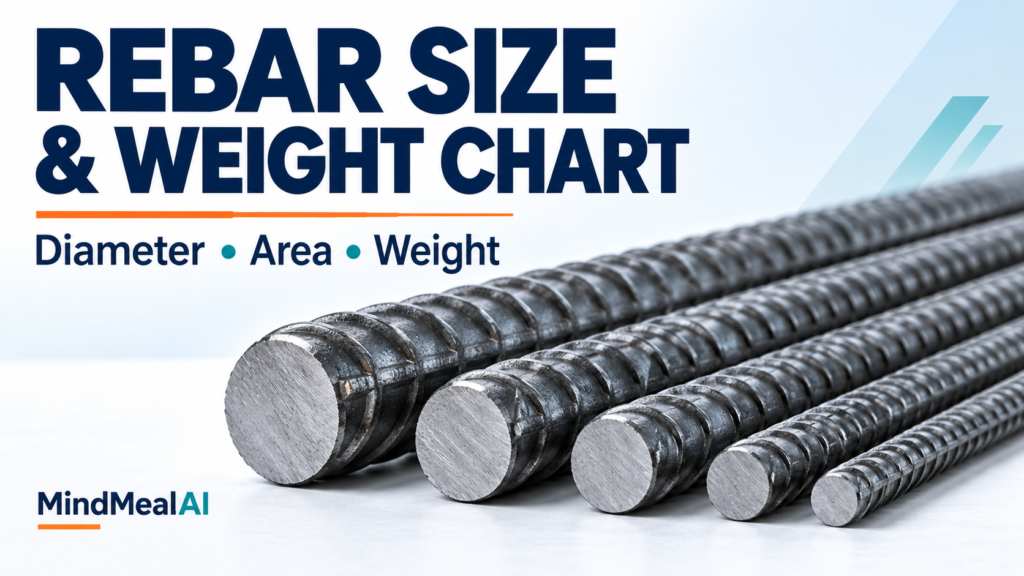
Use this Rebar Size and Weight Chart to check U.S. reinforcing-bar numbers, nominal diameter, cross-sectional area, and weight per foot. Then enter the length and quantity of each bar group to estimate the combined weight in pounds and kilograms.
Rebar Weight Calculator
Choose a bar size, enter the length of one piece, and enter the number of identical pieces. Add another group for a different size or length.
| Group | Size | Length / piece | Qty | Weight / piece | Group weight |
|---|
Based on nominal lb/ft. No automatic allowance for laps, hooks, waste, coatings, or accessories.
U.S. Rebar Size and Weight Chart
Use the listed nominal values for each bar designation. The equivalent metric designation identifies the same U.S. bar family; it is not the exact diameter in millimeters.
| U.S. bar | Metric designation | Diameter (in) | Area (in²) | Weight (lb/ft) |
|---|---|---|---|---|
| #3 | No. 10 | 0.375 | 0.11 | 0.376 |
| #4 | No. 13 | 0.500 | 0.20 | 0.668 |
| #5 | No. 16 | 0.625 | 0.31 | 1.043 |
| #6 | No. 19 | 0.750 | 0.44 | 1.502 |
| #7 | No. 22 | 0.875 | 0.60 | 2.044 |
| #8 | No. 25 | 1.000 | 0.79 | 2.670 |
| #9 | No. 29 | 1.128 | 1.00 | 3.400 |
| #10 | No. 32 | 1.270 | 1.27 | 4.303 |
| #11 | No. 36 | 1.410 | 1.56 | 5.313 |
| #14 | No. 43 | 1.693 | 2.25 | 7.650 |
| #18 | No. 57 | 2.257 | 4.00 | 13.600 |
Metric Conversions for the Same U.S. Bars
Diameter is converted with 25.4 mm/in, area with 645.16 mm²/in², and unit weight with 0.45359237 kg/lb and 0.3048 m/ft. These conversions start from the rounded U.S. table values, so they may differ slightly from independently rounded ASTM metric tables. They do not define Canadian M bars or other national metric sizes.
| U.S. bar | Metric designation | Diameter (mm) | Area (mm²) | Weight (kg/m) |
|---|---|---|---|---|
| #3 | No. 10 | 9.525 | 70.97 | 0.5595 |
| #4 | No. 13 | 12.700 | 129.03 | 0.9941 |
| #5 | No. 16 | 15.875 | 200.00 | 1.5522 |
| #6 | No. 19 | 19.050 | 283.87 | 2.2352 |
| #7 | No. 22 | 22.225 | 387.10 | 3.0418 |
| #8 | No. 25 | 25.400 | 509.68 | 3.9734 |
| #9 | No. 29 | 28.651 | 645.16 | 5.0598 |
| #10 | No. 32 | 32.258 | 819.35 | 6.4036 |
| #11 | No. 36 | 35.814 | 1006.45 | 7.9066 |
| #14 | No. 43 | 43.002 | 1451.61 | 11.3845 |
| #18 | No. 57 | 57.328 | 2580.64 | 20.2390 |
What Does the Rebar Number Mean?
For #3 through #8, the bar number divided by eight gives the nominal diameter in inches: #4 is 4/8 = 1/2 in., and #5 is 5/8 in. For #9 and larger sizes, use the table. A #9 bar is 1.128 in., not exactly 9/8 in.; #14 is 1.693 in., not 1.750 in.
The diameter, area, and unit weight are related, but their published nominal values are rounded separately. For this reason, the calculator uses the listed weight per foot directly. It does not recompute weight from a rounded diameter or area.
How to Calculate Rebar Weight
Example 1: Ten #4 bars, each 20 ft long
Each #4 bar weighs a nominal 0.668 lb/ft. One 20 ft piece weighs 0.668 × 20 = 13.36 lb. Ten pieces weigh 133.60 lb, approximately 60.60 kg. This is the calculator’s starting example.
Example 2: Twelve #5 bars, each 6 m long
Select Meters, choose #5, enter length 6 and quantity 12. The total length is 72 m. Using the converted #5 unit weight of approximately 1.552155 kg/m gives approximately 111.76 kg or 246.38 lb. The tool retains more precision than the rounded chart display.
Example 3: Add a second bar group
Start with ten #4 bars at 20 ft each, then add five #5 bars at 20 ft each. The second group weighs 1.043 × 20 × 5 = 104.30 lb. The combined total is 237.90 lb, approximately 107.91 kg. Keep separate groups when either the bar size or piece length changes.
Which Length Should You Enter?
For straight bars, enter the required piece length. For bent bars, use the developed or cutting length from the approved bar schedule, not just the height or width of the finished shape. A rectangular stirrup’s outside dimensions are not a complete cutting-length specification.
Include lap extensions and hook lengths in the entered piece length only when they are part of that scheduled bar. If you have already included them, do not add them again as a separate allowance. Waste from cutting stock lengths and ordering extra bars is a different estimating step.
Bar Size, Grade, and Specification Are Different
A bar number identifies size. The material specification and grade identify other requirements. A size-and-weight lookup therefore cannot replace a full drawing callout or mill documentation. Check the bar number, required ASTM specification, grade, coating, length, and quantity together.
For ordinary reinforcing steel of the same nominal size, changing the specified strength grade does not create a different nominal weight-per-foot entry in this chart. However, equal nominal weight does not establish that two bars are acceptable substitutes. Material requirements still need to match the project.
Frequently Asked Questions
Does this table include every U.S. rebar size?
No. It covers the eleven listed sizes from #3 through #18. ASTM A615/A615M-20 also includes No. 20 [64], which is outside this lookup. Other sizes and products require their own verified data. The missing numbers are not a reason to invent #12, #13, or other intermediate entries.
Is U.S. #4 the same as a 12 mm metric bar?
No. The U.S. #4 nominal diameter is 12.7 mm. Its equivalent designation is No. 13, but that does not make it a 13 mm exact-diameter bar. Specify the actual standard and bar designation when ordering internationally.
Why might a delivered bundle weigh something different?
This is a nominal estimate. Production variation, coatings, accessories, packaging, and the actual shipped quantity can affect a measured bundle weight. Reconcile an order with the supplier’s documentation rather than treating this calculation as a scale measurement.
Can I use the results to choose reinforcement spacing?
No. The calculator estimates material weight from a size, length, and count that you already know. It does not determine required steel area, bar spacing, development length, splice length, cover, or structural capacity.
Are “tons” shown?
The result uses lb and kg to avoid confusion between a U.S. short ton and a metric tonne. Divide pounds by 2,000 for U.S. short tons, or kilograms by 1,000 for metric tonnes.
Drawing and Quantity Check
- Confirm the bar number and material callout on the approved drawings.
- Check whether the schedule length is per piece or already a group total.
- Keep different lengths and sizes in separate groups.
- Confirm that hooks and laps are counted once.
- Compare the calculated piece count with the bar schedule before ordering.
Related Tools
Use the Feet and Inches Calculator for mixed-unit lengths and the Fraction to Decimal Inches Chart for fractional dimensions.
Data Sources and Calculation Basis
Nominal U.S. dimensions and weights: CRSI, Specialty & Corrosion-Resistant Steel Reinforcement: Product Guide, 1st Edition, 1st Printing, 2013, reinforcing-bar tables. Unit weights were cross-checked against Nucor’s Steel Rebar product page on October 9, 2026. ASTM A615/A615M-20 is cited only for the note that No. 20 [64] also exists; this page does not claim to reproduce its full size table or current grade provisions. SI columns are calculated conversions of the U.S. nominal values.
MindCore