MC vs C Channel: A Simple Guide to Steel Channel Differences
Two steel channels can look almost identical in a drawing and still need different connection details. That is why MC vs C channel is worth understanding before you select a CAD block, check a steel schedule, or compare a supplier’s proposed substitute.
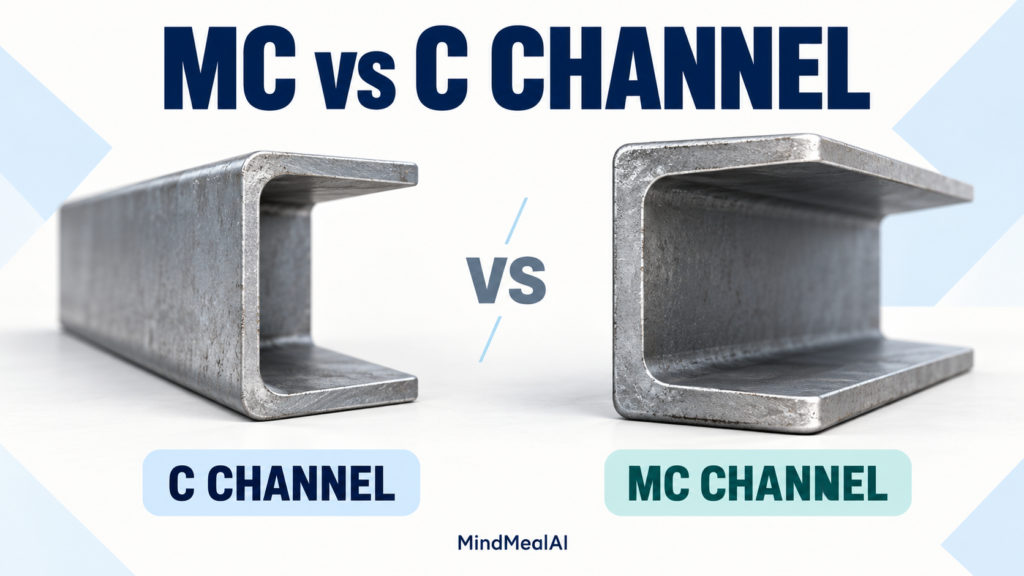
The short answer: C identifies an American Standard Channel, while MC identifies a Miscellaneous Channel. Both are channel-shaped sections, but their dimensions and section properties must be checked by the complete designation. The letters alone do not tell you which member will work better.
This guide covers U.S. hot-rolled structural channels. A thin, cold-formed stud or a custom bent plate may also be called a “C-channel,” but it is a different product.
1. What do C and MC mean?
A channel has a web and two flanges projecting to the same side. Picture a vertical strip of steel with a ledge at the top and bottom.
| Item | C channel | MC channel |
|---|---|---|
| Formal name | American Standard Channel | Miscellaneous Channel |
| Example designation | C12×20.7 | MC12×31 |
| What to look up | Complete C-series entry | Complete MC-series entry |
| Does the prefix specify steel grade? | No | No |
| Does the prefix establish load capacity? | No | No |
“Miscellaneous” does not mean a random scrap section or a shape that must be custom fabricated. MC is a recognized designation used in structural shape tables. Availability of a particular size still needs to be checked.
2. How to read a channel size
In U.S. customary notation, the number before the multiplication sign gives nominal depth in inches. The number after it gives nominal weight in pounds per linear foot.
HOW TO READ MC12×31
10 ft × 31 lb/ft = 310 lb
Self-weight is not load capacity.
For example, a 10-foot length of MC12×31 has a nominal weight of 31 × 10 = 310 lb, before adding plates, bolts, or other attached pieces. C12×20.7 of the same length weighs approximately 207 lb.
Neither label gives the flange width. If you need to know whether the channel fits inside a wall or beside another member, open the dimension table. Also check which unit system the schedule uses: metric designations use nominal depth in millimeters and mass in kilograms per meter.
3. Are MC flanges always parallel?
No. Do not use that as a universal rule. Nucor-Yamato describes the inside flange slope of C shapes as approximately 16⅔%, while the inside flange slope of MC shapes varies. A 16⅔% slope is a rise-to-run ratio of about 1:6; it does not mean an angle of 16⅔ degrees.
For drafting, the useful question is: “What is the flange geometry of this exact section?” A generic channel symbol cannot answer that. This matters when a plate, washer, or other component must bear against an inside flange face.
4. A real comparison: C12×20.7 vs MC12×31
The following nominal dimensions show why matching the depth does not guarantee a matching fit.
| Property | C12×20.7 | MC12×31 |
|---|---|---|
| Weight per foot | 20.7 lb/ft | 31.0 lb/ft |
| Depth, d | 12.00 in. | 12.00 in. |
| Overall flange width, bf | 2.942 in. | 3.670 in. |
| Web thickness, tw | 0.282 in. | 0.370 in. |
| Average flange thickness, tf | 0.501 in. | 0.700 in. |
Source: Nucor-Yamato Steel, Structural Shapes, C and MC dimension tables revised March 2024. These are nominal catalog values, not field measurements.
SAME DEPTH. DIFFERENT FIT.
C12×20.7
Overall width: 2.942 in.
depth
Web thickness: 0.282 in.
Projection beyond web: 2.660 in.
MC12×31
Overall width: 3.670 in.
depth
Web thickness: 0.370 in.
Projection beyond web: 3.300 in.
In this pair, the MC section extends 0.728 in. farther from the back of the web to the flange tip. Imagine replacing the C with the MC while keeping the back of the web in the same location: the top and bottom flange tips move outward by that amount. A nearby wall finish or plate may now be in the way.
There is another useful distinction. Overall width is measured from the back of the web. Projection beyond the inside face of the web is bf − tw: 2.660 in. for the C and 3.300 in. for the MC in this example. That projection is not all usable flat connection space because the root fillet occupies part of it.
These two sections illustrate a fit difference. They do not prove that every MC channel is wider or heavier than every C channel.
5. Is MC channel stronger than C channel?
There is no strength ranking based on the prefix alone. For a beam, the engineer considers the exact section, steel grade, bending direction, span, loading, and lateral restraint. Deflection and connection behavior also matter.
Two table entries that help explain this are moment of inertia (I), which affects bending stiffness, and section modulus (S), which relates bending moment to elastic bending stress. Neither is a complete load rating.
A channel is also an open section. A load applied away from its shear center can introduce twisting, so the location of the load and the restraints deserve attention. A larger weight-per-foot number cannot settle that issue by itself.
6. A practical drawing check before changing the section
Suppose a drawing calls for C12×20.7, but the supplier proposes MC12×31. The shared “12” is a starting point for comparison, not approval to substitute. Use these questions to organize the review:
- Is the reference face staying in place? Check whether the layout controls the back of web, centerline, or flange tip. A change affects each reference differently.
- Will the connection still fit? Review bolt locations, edge distances, fillet clearance, plate dimensions, and access for installation or welding.
- Does the detail depend on an inside flange face? Confirm the actual taper and bearing arrangement rather than assuming a flat surface.
- Has the engineer checked the proposed member? Include strength, deflection, stability, grade, and connection requirements.
- Do all documents match the accepted change? Update plans, schedules, details, material lists, and model properties together after approval.
A useful coordination note is specific: “Proposed MC12×31 in lieu of C12×20.7; verify member adequacy and connection revisions.” Merely changing the text above an unchanged CAD profile can hide the very difference the review needs to catch.
7. Frequently asked questions
Does MC mean “metric channel”?
No. It means Miscellaneous Channel. Both C and MC designations can be expressed in U.S. customary or metric units.
Can I use a generic C-shaped CAD block for either one?
A simple symbol may communicate orientation in a schematic. For a dimensioned detail or coordination model, select the exact section and verify the geometry against its source table.
Which should I choose first?
Start with the project’s required performance and available space. Compare suitable sizes, connection details, and supplier availability. A letter prefix is not a selection method.
What to remember
Read the full designation, check the actual dimensions, and review the connection. C and MC identify different channel families; they do not replace a section table or an engineering check. When two channels share the same depth, the next question should be: “What else changes?”
Related reading on MindMealAI: Steel Channel Sizes: C-Channel Dimensions and Weight Chart; Steel Connection Design: How Forces Travel Through Bolts, Welds, and Plates.
Technical references
- AISC, Naming Convention for Structural Steel Products for Use in Electronic Data Interchange (EDI), Section 3: Channels.
- Nucor-Yamato Steel, Structural Shapes: General Notes (April 2023) and C/MC dimension tables (March 2024).
- AISC, Shapes Database v16.0: section dimensions and properties.
This article explains shape identification and detailing considerations. Illustrations are educational; project-specific member selection and substitutions require engineering review.
MindCore