Round HSS vs Pipe: Sizes, ASTM Grades, and Drawing Checks
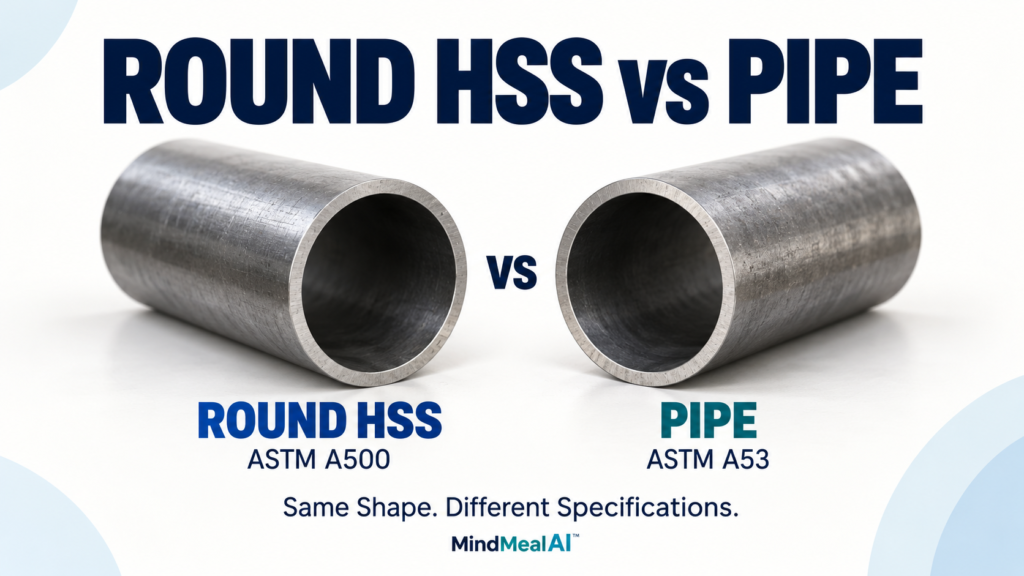
A round member in a steel drawing can be easy to recognize and surprisingly easy to specify incorrectly. “Round HSS” and “pipe” may look alike, but those labels do not tell the purchasing team the same thing.
This round HSS vs pipe guide explains the difference using one practical example: a round HSS and a standard-weight pipe with the same nominal outside diameter and wall thickness. It focuses on U.S. carbon-steel building applications, particularly ASTM A500 HSS and ASTM A53 pipe.
1. Round HSS vs Pipe at a Glance
| Question | Round HSS | ASTM A53 pipe |
|---|---|---|
| What does the name mean? | Round hollow structural section | A pipe product manufactured to ASTM A53 |
| Typical intended use | Structural members | Mechanical and pressure applications; some structural uses |
| Common material in this comparison | ASTM A500 Grade C | ASTM A53 Grade B |
| How is size stated? | Outside diameter × nominal wall thickness | Nominal pipe size plus schedule or weight class |
| Can the cross-sections match? | Yes. Some sizes share the same nominal outside diameter and wall thickness. | |
“Pipe” is a broad product term. This comparison does not cover every pipe specification, such as pipe piles or all industrial process piping. Always read the ASTM designation instead of judging the material from its circular shape.
2. How to Read Round HSS and Pipe Sizes
Consider HSS5.563×0.258. In U.S. customary notation, 5.563 is the specified outside diameter in inches, and 0.258 is the nominal wall thickness in inches. The designation tells you the geometry; the material specification and grade must also be stated in the project documents.
Now compare Pipe 5 Std. The “5” is the nominal pipe size, or NPS. It does not mean that the pipe measures exactly 5 inches across. AISC identifies this size as having a 5.563-inch outside diameter and a 0.258-inch nominal wall.
SAME NOMINAL GEOMETRY ≠ SAME SPECIFICATION
HSS5.563×0.258
Example: ASTM A500 Grade C
Outside diameter: 5.563 in.
Nominal wall: 0.258 in.
Pipe 5 Std.
Example: ASTM A53 Grade B
Outside diameter: 5.563 in.
Nominal wall: 0.258 in.
If a detail requires an opening around this member, drawing a 5.000-inch circle because the schedule says “Pipe 5” starts the detail with the wrong outside dimension. The nominal size is a naming convention, not a substitute for the dimensional table.
3. What Does Schedule 40 or Schedule 80 Mean?
A pipe schedule identifies a wall-thickness series. At the same NPS, Schedule 80 has a thicker wall than Schedule 40, while the outside diameter remains the same. The opening inside becomes smaller.
SAME OUTSIDE DIAMETER. DIFFERENT WALL.
NPS 5 — Schedule 40
Standard weight at this size
Outside diameter: 5.563 in.
Nominal wall: 0.258 in.
Calculated inside diameter: 5.047 in.
NPS 5 — Schedule 80
Extra strong at this size
Outside diameter: 5.563 in.
Nominal wall: 0.375 in.
Calculated inside diameter: 4.813 in.
For the NPS 5 example, the nominal inside diameters are calculated as follows:
- Schedule 40: 5.563 − 2(0.258) = 5.047 in.
- Schedule 80: 5.563 − 2(0.375) = 4.813 in.
These are geometry calculations, not fit-up tolerances. If another piece must slide inside, check actual clearances, permitted dimensional variation, and any internal weld bead.
Also, Schedule 40 does not mean a 0.040-inch wall or a 40-psi pressure rating. The wall thickness depends on NPS. For example, Wheatland lists Schedule 40 nominal walls of 0.237 in. for NPS 4, 0.258 in. for NPS 5, and 0.280 in. for NPS 6.
At NPS 5, Standard weight matches Schedule 40 and Extra Strong matches Schedule 80. Do not extend those equivalences to every pipe size without checking the table.
4. Material Grade Matters Even When the Dimensions Match
The ASTM specification establishes requirements that a size label cannot provide. These include material properties, manufacturing requirements, and tolerances.
| Material | Minimum specified yield strength, Fy |
|---|---|
| ASTM A500 Grade C round HSS, reflecting the 2021 revision | 50 ksi |
| ASTM A53 Grade B pipe | 35 ksi |
Sources: Steel Tube Institute, ASTM A500; Wheatland Tube, ASTM A53 Type E Grade B submittal sheet. Confirm the edition and grade required by the project.
Older references may list 46 ksi for A500 Grade C rounds. STI explains that the 2021 revision increased the round Grade C minimum to 50 ksi. For an existing structure, do not assign the newer strength to older material without supporting documentation.
The strength difference does not mean one finished member automatically carries a fixed percentage more load. Column length, buckling, wall slenderness, connection behavior, and loading also affect the result. A material-strength comparison is only one part of a structural review.
5. Nominal Wall Thickness Is Not Always Design Wall Thickness
The wall stated in an HSS designation is the nominal wall. For electric-resistance-welded ASTM A500 HSS, AISC design practice uses a design wall thickness of 0.93 times the nominal thickness.
For the example HSS, 0.93 × 0.258 = 0.23994 in., approximately 0.240 in. This is a calculation convention that accounts for permitted variation. It does not change the ordering designation to HSS5.563×0.240.
ASTM A1085 HSS uses a different basis: nominal thickness can be used as design thickness. Use section properties corresponding to the actual specification, and do not reduce properties a second time when the table already includes the required reduction.
6. A Practical Drawing Review: Can Pipe Replace Round HSS?
Imagine a drawing calls for HSS5.563×0.258, ASTM A500 Grade C. A supplier offers Pipe 5 Std., ASTM A53 Grade B, explaining that the dimensions match.
The outside profile may fit the drawing, but that answers only the geometry question. A useful substitution review separates three issues:
- Geometry: Confirm outside diameter, wall thickness, length, end condition, and connection fit.
- Material: Compare the ASTM specification, grade, and material test report with the project requirements.
- Engineering: Have the responsible engineer review member and connection adequacy before accepting the change.
For a drafter, this means keeping the model, member schedule, material notes, and details consistent. Renaming a pipe family “HSS” does not verify its section properties or the material that will be purchased.
Finally, ask the supplier about the exact size and grade early. A section listed in software is not proof that it is stocked locally. STI notes that round HSS using standard pipe outside diameters can be easier to source, but the desired wall thickness and material still need confirmation.
7. Frequently Asked Questions
Is round HSS just another name for pipe?
In casual conversation the terms may overlap. In construction documents, keep the size designation and material specification explicit so the fabricator knows what product is required.
Can ASTM A53 pipe be used as a structural member?
Yes, when the applicable design and project specification permit it and the engineer has designed for that material. It is not an automatic substitute for specified A500 HSS.
Can structural HSS be substituted into a pressure line?
Do not infer pressure-service suitability from structural strength or matching dimensions. The piping specification and required product testing must be satisfied separately.
Is the first number in a round HSS label the inside diameter?
No. It is the outside diameter. To estimate the nominal inside diameter, subtract twice the nominal wall thickness, then check tolerances if clearance matters.
What to Check Before You Order
Read the size, read the ASTM grade, and check the connection. A round HSS and a pipe can share a nominal cross-section while remaining different specified products. The best drawing removes that ambiguity before material reaches the shop.
Technical References
- AISC, HSS Frequently Asked Questions, particularly the round HSS and pipe designation discussion.
- Steel Tube Institute, ASTM A500; Steel Tube Specifications: Side-by-Side Reference Table (March 2025); Round HSS Availability.
- AISC, ASTM A1085 section-property resources.
- Wheatland Tube, ASTM A53 Type E Grade B Pipe Submittal Data Sheet, document WST-050625.
Educational guide for U.S. carbon-steel products. Dimensions are nominal. Project specifications and engineering review govern member selection and substitutions.
MindCore